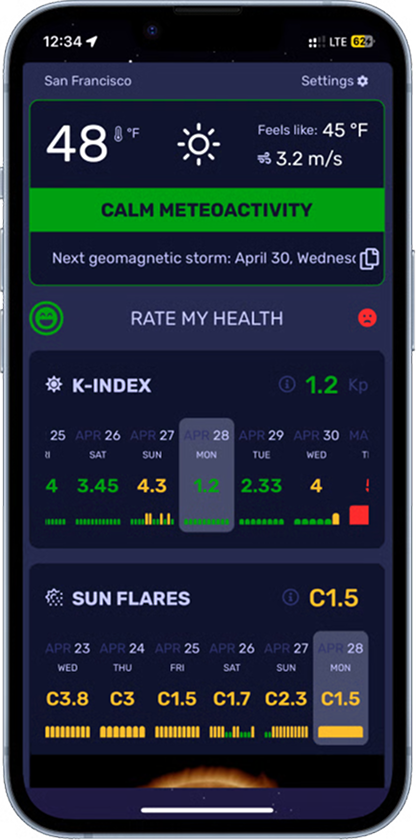
Une personne sur trois sur la planète ressent aussi cela
Vent solaire aujourd'hui : Prévisions en direct du vent solaire (octobre 2026)
Up-to-date solar wind speed and density readings — data from NOAA, NASA, and other official space weather sources. Live solar wind forecast, updated in real time.
What Is the Solar Wind
The solar wind is a continuous stream of charged particles — mostly electrons and protons — flowing outward from the Sun's outer atmosphere (the corona) at high speed. Unlike a solar flare or a CME, which are discrete events, the solar wind never stops: it fills the entire solar system and is what shapes the heliosphere, the vast magnetic bubble the Sun carves out of interstellar space.
The solar wind carries the Sun's magnetic field with it, stretched into a spiral shape by the Sun's rotation (the Parker spiral). When this embedded magnetic field points southward as it reaches Earth, it can connect efficiently with our planet's own magnetic field — a key factor in whether incoming solar wind triggers a geomagnetic disturbance or passes by with little effect.
Where the Solar Wind Comes From
The solar wind isn't uniform — its speed depends on where on the Sun it originated:
Slow solar wind (roughly 300–500 km/s) streams from the Sun's equatorial streamer belt, a region of closed magnetic loops near the solar equator.
Fast solar wind (roughly 500–800 km/s, sometimes higher) escapes through coronal holes — regions where the Sun's magnetic field lines open directly into space, letting particles stream out largely unobstructed.
Because the Sun rotates roughly every 27 days, a coronal hole facing Earth tends to send a fast wind stream our way, then rotate out of view, then rotate back — producing a recurring, roughly monthly pattern of elevated solar wind speed that's distinct from the more random timing of flares and CMEs.
Solar Wind Classification and Key Indicators
There's no official G-scale for the solar wind itself (that scale describes the geomagnetic storm it can cause). Instead, forecasters track a handful of measured parameters directly:
Speed — typically 300–500 km/s for slow wind, 500–800+ km/s for fast streams from coronal holes.
Density — the number of particles per cubic centimeter reaching Earth; low but fast wind can still be geoeffective.
Interplanetary magnetic field (IMF) orientation, especially the Bz component — a sustained southward Bz is the single strongest predictor of whether solar wind will couple with Earth's magnetosphere and drive a storm.
Sustained high-speed streams from coronal holes are typically associated with moderate (G1–G2), recurrent geomagnetic storms, while the fastest, densest solar wind — usually driven by a CME rather than a coronal hole — is behind the strongest (G3 and above) storms.
Solar Wind and Solar Cycle 25
Fast solar wind streams from coronal holes don't peak alongside sunspots and flares — they're typically most frequent during the declining phase of the solar cycle, as large, stable coronal holes become more common. As Solar Cycle 25 moves past its maximum, coronal-hole-driven fast wind streams — and the recurrent, moderate geomagnetic activity they bring — are expected to become a larger share of overall space weather activity, even as flare and CME frequency gradually decreases.
Established Effects of the Solar Wind on Earth
Geomagnetic storms. High-speed streams and, especially, CME-driven solar wind are the direct trigger for geomagnetic storms of all strengths.
Auroras. Energy from the solar wind, funneled along magnetic field lines toward the poles, is what powers the aurora borealis and aurora australis.
Satellites and the ISS. Sustained fast solar wind can heat and expand the upper atmosphere, increasing drag on low-orbit satellites.
Radio communication and GPS. During the geomagnetic disturbances solar wind triggers, shortwave radio and satellite navigation accuracy can be affected.
Power grids. The geomagnetically induced currents from solar-wind-driven storms place extra stress on transformers and power lines.
Possible Effects of Solar Wind–Driven Activity on Health and Wellbeing
Starting with the work of A.L. Chizhevsky in the 1930s (heliobiology), a large body of observations has accumulated: a number of statistical studies find a link between geomagnetic activity levels — including the recurrent, moderate storms driven by high-speed solar wind streams — and the frequency of heart attacks, blood pressure spikes, sleep disturbances, and changes in wellbeing among weather-sensitive people. Proposed mechanisms include effects on melatonin and cortisol production, blood viscosity, and cryptochrome proteins that are sensitive to magnetic fields.
That's why we describe this as a possible effect: if you notice your wellbeing changing on days of elevated solar wind speed or geomagnetic activity, tracking that alongside the forecast is reasonable and safe. But this is an observation of correlation, not a diagnosis or medical advice.
Scientific Publications
Zenchenko & Breus (2021). The Possible Effect of Space Weather Factors on Various Physiological Systems of the Human Organism. Atmosphere, 12(3), 346 — https://www.mdpi.com/2073-4433/12/3/346
Papadema, Tzanis et al. (2021). Human Physiological Parameters Related to Solar and Geomagnetic Disturbances: Data from Different Geographic Regions. Atmosphere, 12(12), 1613 — https://www.mdpi.com/2073-4433/12/12/1613
The role of solar and geomagnetic activity in endothelial activation and inflammation in the NAS cohort — https://pubmed.ncbi.nlm.nih.gov/35881632/
Exploring the relationship between geomagnetic activity and human heart rate variability — https://pubmed.ncbi.nlm.nih.gov/32306151/
Long-Term Study of Heart Rate Variability Responses to Changes in the Solar and Geomagnetic Environment — https://pubmed.ncbi.nlm.nih.gov/29422633/
Live Solar Wind Forecast
Track solar wind speed, density, and IMF orientation for today and the days ahead — data is updated based on NOAA and NASA observations
Qu'est-ce que le vent solaire, en termes simples ?
C'est un flux constant de particules s'échappant du Soleil dans toutes les directions, à des vitesses typiquement comprises entre 300 et 800 kilomètres par seconde — contrairement à une éruption, il ne s'arrête jamais.
Le vent solaire est-il la même chose qu'une éruption solaire ?
Non. Une éruption solaire est une brusque poussée de rayonnement qui atteint la Terre en 8 minutes. Le vent solaire est un flux continu de particules qui met environ 1 à 4 jours pour atteindre la Terre et est présent à un certain niveau en permanence.
Le vent solaire provoque-t-il les aurores ?
Oui — les aurores sont alimentées par l'énergie du vent solaire canalisée le long des lignes du champ magnétique terrestre vers les pôles ; un vent solaire plus fort et plus rapide (surtout avec un champ magnétique pointant vers le sud) produit des manifestations plus lumineuses et plus étendues.
Quelle est la vitesse actuelle du vent solaire ?
Consultez le traqueur en direct ci-dessus — des vitesses autour de 300–400 km/s sont typiques d'un vent solaire lent et calme, tandis que des lectures soutenues au-dessus de 500–600 km/s indiquent généralement un flux à haute vitesse provenant d'un trou coronal.
D'où proviennent les données de MeteoAgent ?
Agrégées en temps réel depuis NOAA SWPC, NASA et d'autres sources officielles de surveillance météorologique spatiale.