

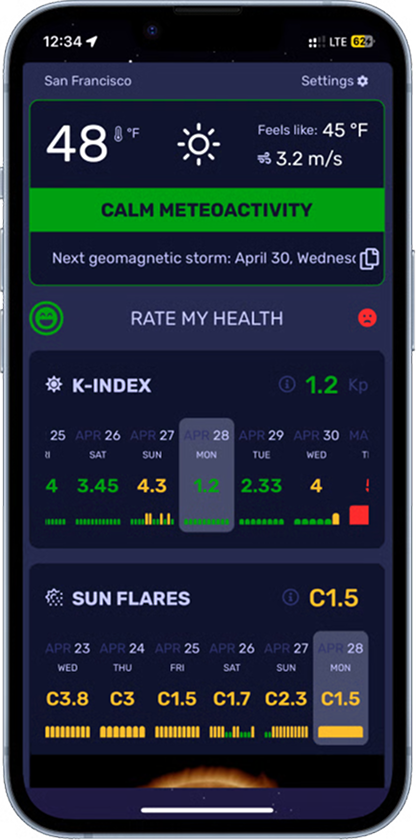


Aurora Forecast: Northern Lights Forecast for Tonight and the Days Ahead
Up-to-date aurora forecast and northern lights forecast — how likely you are to see the aurora tonight, tomorrow, and over the coming days, based on the Kp-index, geomagnetic storm forecast, and cloud cover data from NOAA and other official space weather sources. Live aurora borealis forecast, updated in real time.
What Is the Aurora (Northern Lights)
The aurora — known as the Northern Lights (aurora borealis) in the Northern Hemisphere and the Southern Lights (aurora australis) in the Southern Hemisphere — is the visible glow that appears when charged particles from the Sun collide with gases in Earth's upper atmosphere. Those collisions excite oxygen and nitrogen molecules, which release the energy as light: green and yellow-green from oxygen at lower altitudes, red from oxygen higher up, and blue or purple from nitrogen.
The aurora isn't a separate phenomenon from a geomagnetic storm — it's one of its most visible effects. When a coronal mass ejection (CME) or a fast solar wind stream reaches Earth and disturbs the magnetosphere, some of that energy funnels down along magnetic field lines toward the poles, where it lights up the sky. That's why an accurate aurora forecast depends directly on the geomagnetic storm forecast: no storm, no aurora display beyond the polar ovals.
Aurora Forecast: Kp-Index and Visibility
The Kp-index (0–9) is the same scale used to describe geomagnetic storm strength, and it's the primary number behind any northern lights forecast:
- Kp 0–2 — aurora typically confined to the polar regions (northern Alaska, northern Scandinavia, northern Canada, Svalbard).
- Kp 3–4 — visibility extends to high-latitude areas (southern Alaska, Iceland, northern Scotland, southern Scandinavia).
- Kp 5–6 (G1–G2 storm) — aurora can reach mid-high latitudes (northern US states like Michigan, Washington, and Maine; northern UK; southern Canada).
- Kp 7–8 (G3–G4 storm) — visibility pushes into mid-latitudes (parts of the northern-central US, central Europe).
- Kp 9 (G5 storm) — an extremely rare event where the aurora can be seen far from the poles, even at low-to-mid latitudes.
Alongside the Kp-index, three other factors decide whether you'll actually see anything: darkness (you need several hours of true night sky), clear weather (cloud cover blocks the view completely), and minimal light pollution (city lights wash out all but the strongest displays). A high Kp reading with a cloudy sky still means no aurora — which is why a good aurora forecast tonight combines geomagnetic data with a local cloud-cover forecast.
Northern Lights Near Me: How to Check Your Odds
"Aurora near me" and "northern lights near me" are really two questions in one: how far north (or south) do you need to be, and is tonight's Kp-index high enough to reach your latitude? As a rough rule of thumb, compare your latitude to the visibility bands above — the higher the forecast Kp-index, the farther from the poles the aurora extends. Combining your location with the live Kp forecast above is the most reliable way to answer "can I see the northern lights tonight where I live," rather than relying on a single national-level prediction.
When Is the Best Time to See the Northern Lights
- Time of year. Around the equinoxes (March and September) geomagnetic activity tends to run higher on average, making spring and fall statistically favorable, though strong displays can occur in any season with clear, dark skies.
- Time of night. Aurora activity often peaks in the hours around local midnight, though it can appear anytime during full darkness.
- Solar cycle phase. Aurora sightings at mid-latitudes become more frequent during solar maximum and the years around it, when geomagnetic storms are more common.
Established Effects Linked to Aurora-Producing Storms
Because the aurora is a byproduct of geomagnetic storms, the same storm can bring both a visible display and side effects on technology:
- Power grids. Geomagnetically induced currents from the same storms that drive strong aurora can stress transformers and power lines.
- Satellites and the ISS. Atmospheric drag increases during strong storms, affecting low-orbit satellites.
- GPS and navigation. Accuracy can degrade during the same G3+ storms that push the aurora to mid-latitudes.
- Radio communication. Shortwave radio, especially near the poles, can be disrupted during the storm.
For the full picture of how these storms affect technology and human wellbeing, see our geomagnetic storm forecast page — the aurora is the visible signature of the same event.
Live Aurora and Geomagnetic Forecast
Track the aurora forecast and northern lights forecast for tonight, tomorrow, and the days ahead — data is updated based on NOAA SWPC's Kp-index and OVATION aurora model, combined with geomagnetic storm observations.
Frequently Asked Questions About the Aurora Forecast
Will I see the northern lights tonight?
Check the live Kp-index above against your latitude, and make sure your local sky forecast is clear and dark — a favorable Kp reading is necessary but not sufficient if it's cloudy or still twilight where you are.
How accurate is an aurora forecast?
The Kp-index forecast is reasonably reliable 1–3 days out, similar to the geomagnetic storm forecast it's based on, but short-term (30–90 minute) aurora alerts based on real-time solar wind data are more precise for a specific night.
What Kp-index do I need to see the northern lights from mid-latitudes?
Generally Kp 5 or higher (a G1 geomagnetic storm) is needed to bring visible aurora down to mid-high latitudes; Kp 7+ is typically required for classic mid-latitude locations.
Can I see the northern lights without traveling far north?
Yes, during strong geomagnetic storms (G3 and above) the aurora can become visible at much lower latitudes than usual, though this happens far less often than displays confined to the polar regions.
Is there an aurora forecast map I can check for my location?
The live Kp-index and OVATION-based aurora oval shown above function as a real-time aurora forecast map — compare the southern edge of the oval to your latitude to estimate your local visibility.
Where does MeteoAgent's aurora data come from?
Aggregated from NOAA SWPC's Kp-index and OVATION aurora model, along with other official space weather monitoring sources, updated in real time.