

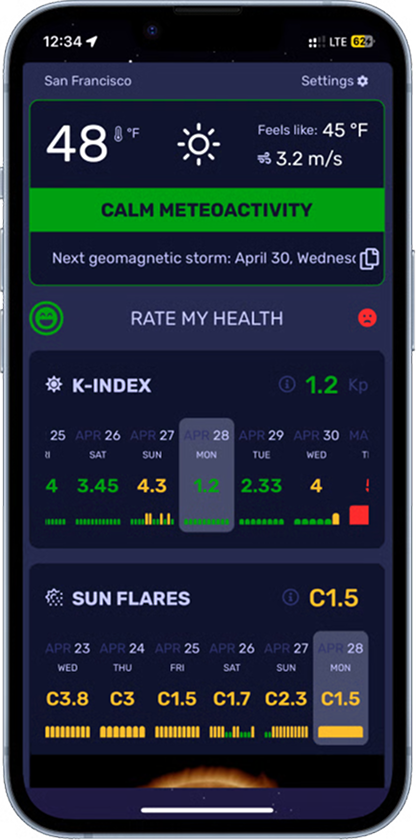


Solar Activity Forecast Today and This Week: Live Monitoring of the Sun
Up-to-date solar activity forecast — data from NOAA, NASA, and other official space weather sources. Live solar activity forecast, updated in real time.
What Is Solar Activity
Solar activity is an umbrella term for all the processes happening on the Sun that are tied to its variable magnetic field: sunspots, flares, coronal mass ejections (CMEs), solar wind streams, and coronal holes. All of these phenomena are part of the same cycle: the Sun's magnetic field twists, builds up energy, and periodically releases it as flares and ejections.
At the core of solar activity is the 11-year solar cycle (the Schwabe cycle): the number of sunspots on the Sun's surface rises from minimum to maximum and back down again. The more sunspots there are, the more often flares and ejections occur, and the more often geomagnetic storms reach Earth. We're currently in Solar Cycle 25: it peaked in October 2024 and has already entered its declining phase — but the declining phase is often when some of the cycle's most powerful storms occur, so it's still worth checking the forecast.
Solar activity is a broad umbrella term: its specific manifestations (flares, geomagnetic storms, the Schumann resonance) work differently and reach Earth at different speeds — from 8 minutes for flares to 1–3 days for storms.
Solar Activity Classification and Indicators
Scientists track several parameters to describe the current level of solar activity:
- Sunspot number (Wolf number) — the basic historical index of solar activity, continuously recorded since the 18th century.
- Flare class (A, B, C, M, X) — based on X-ray emission strength; the higher the letter, the more powerful the flare (see the solar flares page for details).
- Solar wind speed and density — determine how strong the impact on Earth's magnetosphere will be even without a major ejection.
- G-scale and K-index — reflect the overall effect of solar activity on Earth's magnetic field (see the geomagnetic storms page for details).
Periods of high solar activity (rising sunspot numbers, frequent M- and X-class flares), in addition to their effects on technology, are also linked by some people to a possible effect on wellbeing: during such periods, weather-sensitive people sometimes report headaches, blood pressure swings, and sleep disturbances — while others, conversely, report a surge of energy, higher productivity, and increased creativity. The nature of the reaction is individual and depends on the person and the cycle's phase.
Tracking the current phase of the solar cycle and the activity level helps you interpret flare and geomagnetic storm forecasts more precisely.
Established Effects of Solar Activity on Earth
- Radio communication and navigation. High-activity periods increase the frequency and duration of radio disturbances and GPS disruptions.
- Satellites and aviation. During maximum phases, satellite operators and airlines more often adjust equipment operating modes and flight routes.
- Power grids. The increased number of geomagnetic storms during active phases of the solar cycle raises stress on power grids.
- Auroras. The higher the solar activity, the more often — and the farther from the poles — auroras can be observed.
- Climate indicators. On multi-year timescales, solar activity correlates with a number of atmospheric indicators used in climate research.
Possible Effects of Solar Activity on Health and Wellbeing
Starting with the work of A.L. Chizhevsky in the 1930s (heliobiology), a large body of observations has accumulated: a number of statistical studies find a link between solar activity levels (sunspot number, cycle phase) and the frequency of heart attacks, blood pressure spikes, sleep disturbances, and changes in wellbeing among weather-sensitive people. Proposed mechanisms include effects on melatonin and cortisol production, blood viscosity, and cryptochrome proteins that are sensitive to magnetic fields.
That's why we describe this as a possible effect: if you notice your wellbeing changing during periods of high solar activity, tracking that alongside the forecast is reasonable and safe. But this is an observation of correlation, not a diagnosis or medical advice.
Track the solar activity forecast for today, tomorrow, and the days ahead — data is updated based on NOAA and NASA observations.
Frequently Asked Questions About Solar Activity
What does high solar activity mean? It's a period when the Sun has many sunspots, M- and X-class flares occur frequently, and the likelihood of geomagnetic storms on Earth is elevated.
What phase of the solar cycle are we in right now? Solar Cycle 25 passed its peak activity in October 2024 and is currently in its declining phase, which can last several years while still being a period of notable activity.
Are solar activity, flares, and geomagnetic storms the same thing? No, they're related but distinct concepts. Solar activity is the Sun's overall process level. A flare is a specific burst of radiation (8 minutes to Earth). A geomagnetic storm is Earth's magnetosphere reacting to a coronal mass ejection that arrives 1–3 days later.
How often does the solar cycle change? A full cycle lasts an average of 11 years — from one minimum to the next — with peak activity roughly at the midpoint.
Where can I check today's solar activity forecast? An up-to-date solar activity forecast is available in the MeteoAgent app and updates in real time based on NOAA SWPC and NASA data.
What is solar activity?
Solar activity is the general term for everything happening on and around the Sun that can affect Earth: sunspots and active regions on the solar surface, the X-ray and ultraviolet output they produce, the ongoing flow of solar wind, and episodic events like solar flares and coronal mass ejections (CMEs).
Is solar activity a forecast or a real-time reading?
It's a real-time reading, not a forecast — this page presents a solar activity now snapshot, showing what the Sun is doing at this exact moment based on the latest readings from ground- and space-based instruments, continuously updating rather than issuing a daily summary.
Does solar activity ever stop completely?
No. Solar activity is a continuous, always-present background condition — it's low during solar minimum and high during solar maximum, but it never fully stops.
What are the three main signals tracked by a solar activity monitor?
The three main signals are sunspot number and active regions (the count and complexity of visible sunspot groups), X-ray flux (the background X-ray output of the Sun measured continuously by GOES satellites, with sudden spikes corresponding to flares), and solar wind parameters (speed, density, and magnetic field orientation of the particle stream leaving the Sun).
How does solar activity affect radio communication and GPS?
Elevated X-ray flux and flares ionize the upper atmosphere, occasionally disrupting shortwave radio on Earth's sunlit side, and satellite navigation accuracy can degrade briefly during periods of high solar activity.
Does solar activity affect airlines and satellites?
Yes. Airlines and satellite operators adjust routes and equipment modes when solar activity readings climb, since sustained high solar activity raises the odds of a geomagnetic storm reaching Earth.
Can solar activity affect human health and wellbeing?
A large body of observations, starting with the work of A.L. Chizhevsky in the 1930s (heliobiology), has found statistical links between solar and geomagnetic activity levels and the frequency of heart attacks, blood pressure spikes, sleep disturbances, and changes in wellbeing among weather-sensitive people.
What mechanisms might explain solar activity's effect on the body?
Proposed mechanisms include effects on melatonin and cortisol production, blood viscosity, and cryptochrome proteins that are sensitive to magnetic fields.
Is the link between solar activity and health scientifically proven?
Not conclusively — this is described as a possible effect, since the observed relationship is a correlation, not a diagnosis or medical advice. If you notice your wellbeing changing during periods of elevated solar activity, tracking that alongside live readings is reasonable and safe.
Where does this page's solar activity data come from?
Data is aggregated from NOAA, NASA, and other official space weather monitoring sources in real time, combining sunspot counts, X-ray flux, and solar wind readings as they arrive from observatories.