Geomagnetic Storms Today: Live Forecast and K-index Levels (October 2026)
NOW: Kp 1.6 — Quiet
↑MAX: 3.3 ↓MIN: 0.6
Geomagnetic storms today and current K-index levels — up-to-date data from NOAA, NASA, and other official space weather sources. This live geomagnetic storm forecast — also commonly searched as a magnetic storm forecast — and geomagnetic activity tracker is updated in real time.
What Is a Geomagnetic Storm
A geomagnetic storm — often called a magnetic storm in everyday language, and occasionally nicknamed a "geostorm" — is a disturbance of Earth's magnetic field. It happens when a coronal mass ejection (CME), a cloud of plasma ejected by the Sun, or a fast stream of solar wind reaches our planet. A solar flare arrives in 8 minutes; a geomagnetic storm today is usually the result of a slower, delayed event, since a CME typically takes 1–3 days to reach Earth after the eruption.
Because scientists can track the eruption on the Sun and estimate its speed and direction, they can issue a warning 1–3 days before the storm arrives — geomagnetic storms, unlike flares, can be forecast in advance. A magnetic storm today isn't always tied to a solar flare: a CME can occur without a major flare, and a powerful solar flare may have no ejection at all.
What Causes Geomagnetic Storms?
The primary triggers of geomagnetic storms are fascinating phenomena that originate from our Sun's dynamic activity. These powerful disturbances can be traced to several specific solar events:
Coronal Mass Ejections (CMEs) - massive bursts of solar wind and magnetic fields released from the Sun's corona, carrying billions of tons of solar material into space at speeds reaching millions of miles per hour
Solar flares - intense bursts of radiation from the Sun's surface that release enormous amounts of energy across the electromagnetic spectrum, from radio waves to X-rays and gamma rays
High-speed solar wind streams emanating from coronal holes - these are regions in the Sun's atmosphere where magnetic field lines open into space, allowing solar wind to escape at particularly high velocities
Geomagnetic Storm Classification and Strength
NOAA classifies geomagnetic storms on the G-scale, from G1 to G5. Each level reflects an increasing strength of impact on Earth's magnetosphere:
G1 (minor) — small fluctuations in power grids; auroras visible only at high latitudes near the poles
G2 (moderate) — possible localized power supply issues; auroras shift closer to mid-high latitudes
G3 (strong) — disruptions to satellite operation and navigation; auroras visible at mid-latitudes
G4 (severe) — significant stress on power systems, possible outages; auroras visible far from the poles
G5 (extreme) — an extremely rare event; risk of widespread power grid outages, transformer damage, and satellite disruptions. Example: the 1859 Carrington Event
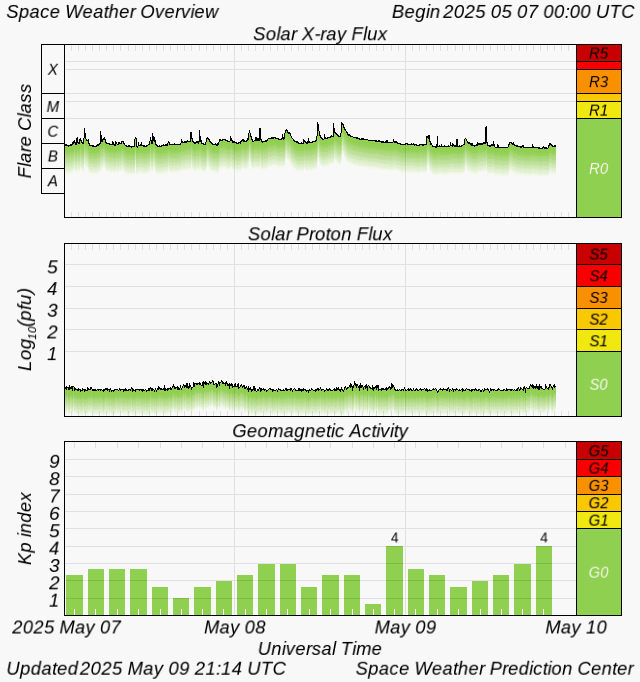
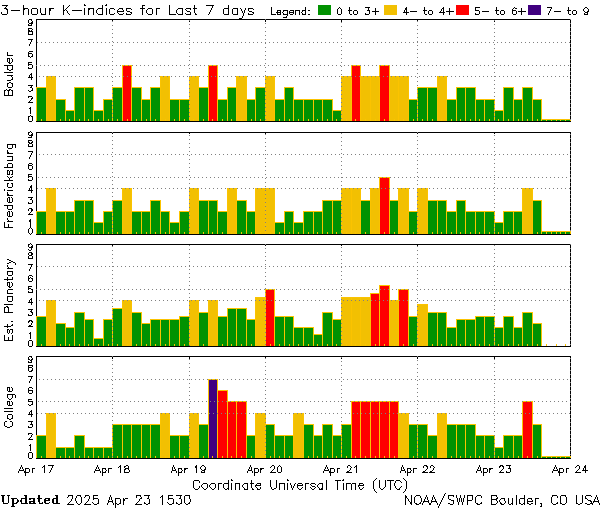
Storm intensity is also reflected by the K-index (0–9) — the higher the value, the stronger the geomagnetic disturbance at that moment, and the more useful it is for reading a geomagnetic storm calendar of recent and upcoming activity at a glance.
G3-and-above storms, in addition to their effects on technology, may also have a possible effect on human wellbeing: on the days of such storms, weather-sensitive people often report headaches and migraines, blood pressure spikes, and sleep issues — while others, conversely, report a boost of energy and strength, increased creativity and inspiration.
The nature and intensity of the reaction is individual and depends on the strength of the specific storm. Understanding a storm's level helps you interpret the geomagnetic activity forecast more precisely and gauge how strong its effect on Earth will be.
Established Effects of Geomagnetic Storms on Earth
Auroras. The stronger the storm, the farther from the poles the aurora can be seen — during G4–G5 events it's sometimes visible even at mid-latitudes.
Power grids. Geomagnetically induced currents place extra stress on transformers and power lines, in rare cases leading to outages.
Satellites and the ISS. The atmosphere expands during strong storms, increasing drag on low-orbit satellites and shortening their lifespan; operators adjust orbits and equipment modes accordingly.
GPS and navigation. Satellite navigation accuracy can degrade noticeably during strong storms.
Radio communication. Shortwave radio, especially in polar regions, can be disrupted for the duration of a storm.
Magnetic Storm Calendar
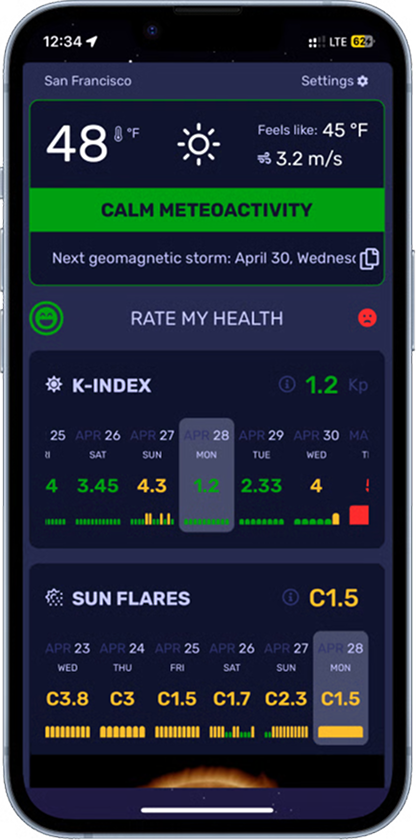
The magnetic storm calendar above displays live K-index readings as a continuously updating graph. It shows today's geomagnetic storm activity alongside recent history and any upcoming activity in one view, whether you're tracking storms for their technological impact or for their possible effect on your own wellbeing.
Protection and Preparation
Organizations and individuals can prepare for geomagnetic storms by:
Monitoring space weather forecasts and alerts.
Implementing backup systems for critical infrastructure.
Following recommended safety protocols during severe storms.
Having alternative communication methods ready.
Understanding and tracking geomagnetic storms is crucial for maintaining our technological infrastructure and protecting sensitive systems from potential damage.
Possible Effects of Geomagnetic Storms on Health and Wellbeing
Starting with the work of A.L. Chizhevsky in the 1930s (heliobiology), a large body of observations has accumulated: a number of statistical studies find a link between geomagnetic activity levels and the frequency of heart attacks, blood pressure spikes, sleep disturbances, and changes in wellbeing among weather-sensitive people. Proposed mechanisms include effects on melatonin and cortisol production, blood viscosity, and cryptochrome proteins that are sensitive to magnetic fields.
That's why we describe this as a possible effect: if you notice your wellbeing changing on days of geomagnetic storms, tracking that alongside the forecast is reasonable and safe. But this is an observation of correlation, not a diagnosis or medical advice.
Scientific Publications
Myocardial infarct and geomagnetic disturbances: analysis of data on morbidity and mortality — https://pubmed.ncbi.nlm.nih.gov/9783069/
Gaisenok et al. (2025). The Influence of Geomagnetic Storms on the Risks of Developing Myocardial Infarction, Acute Coronary Syndrome, and Stroke: Systematic Review and Meta-analysis. — https://pubmed.ncbi.nlm.nih.gov/40256184/
Effect of Simulated Geomagnetic Activity on Myocardial Ischemia/Reperfusion Injury in Rats — https://pubmed.ncbi.nlm.nih.gov/31364342/
Geomagnetic pulsations and myocardial infarctions — https://pubmed.ncbi.nlm.nih.gov/16821424/
Exploring the Potential Observations Between Geomagnetic Activity and Cardiovascular Events: A Scoping Review — https://pmc.ncbi.nlm.nih.gov/articles/PMC12822803/
The effect of geomagnetic activity on cardiovascular parameters — https://pubmed.ncbi.nlm.nih.gov/12653177/
Geomagnetic disturbances reduce heart rate variability in the Normative Aging Study — https://pubmed.ncbi.nlm.nih.gov/35644403
Synchronization of Human Autonomic Nervous System Rhythms with Geomagnetic Activity in Human Subjects — https://pubmed.ncbi.nlm.nih.gov/28703754/
Exploring the relationship between geomagnetic activity and human heart rate variability — https://pubmed.ncbi.nlm.nih.gov/32306151/
Long-Term Study of Heart Rate Variability Responses to Changes in the Solar and Geomagnetic Environment — https://pubmed.ncbi.nlm.nih.gov/29422633/
Live Geomagnetic Storm and K-index Forecast
Geomagnetic Storms: Full Archive
Is there a geomagnetic storm today?
Check the live K-index widget above — a reading of 5 or higher means a storm of G1 strength or greater is either underway or expected within the next few hours.
When is the next geomagnetic storm?
Because storms are driven by CMEs and high-speed solar wind streams, the next geomagnetic storm can usually be forecast 1–3 days out once an eruption is spotted on the Sun. Check the live tracker above for the latest outlook rather than a fixed schedule.
What's the difference between a magnetic storm and a solar flare?
They're different phenomena. A flare is radiation that reaches Earth in 8 minutes. A magnetic (geomagnetic) storm is Earth's magnetosphere reacting to a coronal mass ejection (CME) that arrives 1–3 days later.
What is the K-index?
The K-index is a scale from 0 to 9 that reflects the intensity of geomagnetic disturbances at a given moment. Values of 5 and above correspond to the onset of a storm (G1 or stronger).
How often do magnetic storms occur?
The frequency and strength of storms is directly tied to the phase of the 11-year solar cycle: strong storms (G3 and above) occur significantly more often during solar maximum and the declining phase of the cycle.
Where can I check the magnetic storm calendar online?
An up-to-date geomagnetic storm forecast and K-index calendar is available in the MeteoAgent app and on this page, updating in real time based on NOAA SWPC and NASA data.