Solar Flares Today: Live Solar Flare Forecast and Activity Levels (October 2026)
NOW: B8.3
↑MAX: B8.3 ↓MIN: B7.4
Solar flares today and current solar activity levels — up-to-date data from NOAA, NASA, and other official space weather sources. This live solar flare forecast and solar flares online tracker is updated in real time.
What Is a Solar Flare
A solar flare is a sudden burst of X-ray and ultraviolet radiation, released when tangled magnetic field lines on the Sun's surface break and reconnect (magnetic reconnection), releasing energy comparable to millions of hydrogen bombs within minutes.
Because a flare is radiation, it travels at the speed of light and reaches Earth in about 8 minutes. This means the flare itself can't be predicted in advance — we only learn about it the moment it happens (though a person may sense it approaching). That immediacy is exactly why so many people check for solar flares today rather than relying on a forecast made days in advance.
Separately from the flare, the Sun sometimes ejects a coronal mass ejection (CME) — a cloud of plasma that travels more slowly (1–3 days) and, upon reaching Earth, can trigger a geomagnetic storm. A flare and a CME often occur together, but not always: a powerful flare may have no ejection at all, and vice versa.
Solar Flare Classification and Strength
NOAA and NASA classify solar flares by the strength of their X-ray emission. Each letter in the solar flare classification is roughly ten times more powerful than the one before it:
A, B, C — background, weak flares; practically no effect on Earth
M — moderate flares; can cause brief radio disturbances in polar regions
X — the most powerful solar flares, the highest class; the largest ever recorded (2003) is estimated at roughly X45
M- and X-class flares, in addition to affecting radio communication and navigation, may also have a possible effect on human wellbeing: on the days of such flares, weather-sensitive people often report headaches and migraines, digestive issues — while others, conversely, report a boost of energy and strength, increased creativity and inspiration. The nature and intensity of the reaction is individual and depends on the strength of the specific flare. People searching for a solar flare migraine connection are usually describing exactly this pattern — a headache or migraine that tracks with M- and X-class activity rather than a diagnosed medical cause.
Understanding a flare's class helps you interpret the solar activity forecast more precisely and gauge how strong its effect on Earth will be.
Established Effects of Solar Flares on Earth and Humans
Human wellbeing. The human body, like all living things on Earth, is directly dependent on the Sun and sensitive to its energy.
Radio communication. Powerful flares (M-class and above) ionize the upper atmosphere and cause brief, sometimes hours-long, disruptions to shortwave radio on Earth's sunlit side.
GPS and navigation. Satellite navigation accuracy can degrade during a flare and shortly after.
Satellites and aviation. Airlines adjust polar flight routes, and satellite operators adjust equipment operating modes, when a high-class flare is forecast.
Geomagnetic storms. Powerful flares often (though not always) can trigger a geomagnetic storm on Earth, bringing auroras and stress on power grids.
Possible Effects of Solar Activity on Health and Wellbeing
Starting with the work of A.L. Chizhevsky in the 1930s (heliobiology), a large body of observations has accumulated: a number of statistical studies find a link between solar/geomagnetic activity levels and the frequency of heart attacks, blood pressure spikes, sleep disturbances, and changes in wellbeing among weather-sensitive people. Proposed mechanisms include effects on melatonin and cortisol production, blood viscosity, and cryptochrome proteins that are sensitive to magnetic fields.
That's why we describe this as a possible effect: if you notice your wellbeing changing on days of high solar activity or geomagnetic storms, tracking that alongside the forecast is reasonable and safe. But this is an observation of correlation, not a diagnosis or medical advice.
Scientific publications
Zenchenko & Breus (2021). The Possible Effect of Space Weather Factors on Various Physiological Systems of the Human Organism. Atmosphere, 12(3), 346 — https://www.mdpi.com/2073-4433/12/3/346
Papadema, Tzanis et al. (2021). Human Physiological Parameters Related to Solar and Geomagnetic Disturbances: Data from Different Geographic Regions. Atmosphere, 12(12), 1613 — https://www.mdpi.com/2073-4433/12/12/1613
The role of solar and geomagnetic activity in endothelial activation and inflammation in the NAS cohort — https://pubmed.ncbi.nlm.nih.gov/35881632/(уже есть на главной)
Considering space weather forces interaction on human health: the equilibrium paradigm in clinical cosmobiology — is it equal? — https://pubmed.ncbi.nlm.nih.gov/25418971/
Track the solar flare forecast and geomagnetic conditions for today, tomorrow, and the days ahead with our solar flares online tracker — data is updated based on NOAA and NASA observations.
When Is the Next Solar Flare?
Because flares are unpredictable radiation events rather than something that builds up gradually, there's no fixed schedule for the next solar flare — but sunspot groups with complex magnetic structure are the regions most likely to produce one, and monitoring those groups is how forecasters estimate near-term odds rather than an exact date. Checking the live tracker above is the closest thing to knowing when the next solar flare might occur.
Solar Flares: Full Archive
Can a solar flare be predicted in advance?
Yes, by analyzing sunspot groups on the Sun's surface, but this is very difficult, and current equipment and forecasting technology are still at an early stage.
Are a solar flare and a geomagnetic storm the same thing?
No. A flare is radiation that arrives in 8 minutes. A geomagnetic storm is Earth's magnetosphere reacting to a coronal mass ejection (CME) that arrives 1–3 days later.
How often do solar flares occur?
Flare frequency is directly tied to the phase of the 11-year solar cycle: during solar maximum, flares — including M- and X-class — occur significantly more often than during solar minimum.
Where can I check today's solar flare forecast?
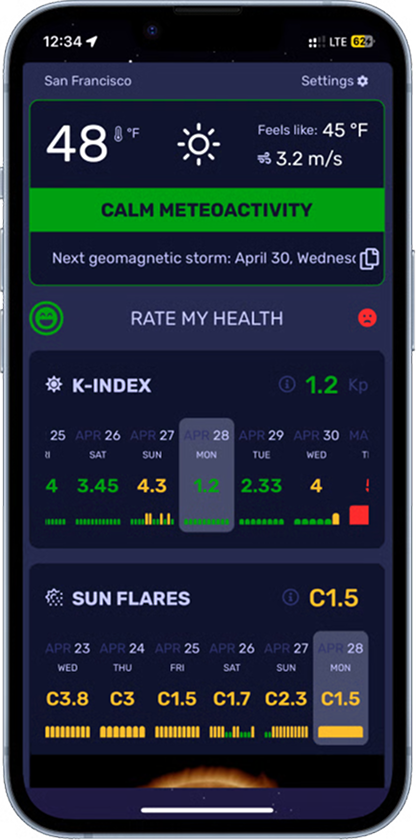
An up-to-date solar flare and solar activity forecast is available in the MeteoAgent app and updates in real time based on NOAA SWPC and NASA data.
Is there a solar flare today?
Check the live tracker above for the current status — solar flares today are only confirmed once the radiation actually reaches Earth's detectors, so this page reflects real-time readings rather than a prediction.
Are there solar flares today?
On any given day there's a good chance of at least a minor (A- or B-class) flare, since low-level activity is common; M- and X-class events are far less frequent and are what the live forecast highlights.
Where does MeteoAgent's data come from?
Aggregated from NOAA SWPC, NASA, and other official space weather monitoring sources in real time.