



Heart Rate Variability
Of all the possible health connections covered in this wiki, heart rate variability has by far the most measurable, quantified research behind it. Unlike vaguer reports of "feeling off," HRV gives researchers an actual number to track — and several independent groups, using different populations in different countries, have found that number moves when the geomagnetic field does.
What Heart Rate Variability Is
Heart rate variability is the beat-to-beat variation in the time between heartbeats. Counterintuitively, more variability is generally the healthier sign: it reflects a nervous system that's actively, flexibly balancing its sympathetic ("fight or flight") and parasympathetic ("rest and digest") branches in response to changing conditions, rather than running on a rigid, unresponsive rhythm. Low HRV is a well-established marker in cardiology, associated with higher cardiovascular risk, and is measured using either time-domain statistics (like the standard deviation between heartbeats) or frequency-domain analysis that separates the signal into different rhythmic components.
What the Research Shows
Several independent studies have found measurable HRV changes tied to geomagnetic activity:
- A subarctic study comparing high-disturbance days to geomagnetically quiet days found a 5.9% increase in average heart rate and a 25.2% decrease in HRV on the disturbed days — a substantial shift for a single environmental variable to be associated with.
- A five-month study tracking 16 participants' HRV continuously found that autonomic nervous system activity consistently responded to changes in solar and geomagnetic conditions during normal, undisturbed periods, with the response beginning at different lags after different types of solar and geomagnetic changes and persisting for varying lengths of time.
- Larger cohort research, including the Normative Aging Study, has linked geomagnetic disturbance to reduced HRV alongside broader associations with cardiovascular and other health outcomes, though the size of the effect varies across studies and populations.
A More Striking (and More Contested) Finding: Synchronization
A separate line of research goes further, reporting that groups of participants' HRV rhythms became synchronized with each other — and with geomagnetic field fluctuations — even while living in different locations and going about ordinary daily life, with a shared rhythm emerging at a period of roughly 2.5 days across a 31-day monitoring window. This is a genuinely striking claim if it holds up, but it comes primarily from one affiliated research group, and results this specific benefit from independent replication by separate teams before being treated as settled — a normal, necessary step for any finding this unusual, not a dismissal of it.
The Cardiovascular Risk Angle
Beyond HRV itself, several studies have looked directly at cardiac events. One long-running analysis found roughly a 5% higher risk of fatal myocardial infarction during years of high solar activity compared to low-activity years in a Minnesota population. A separate study of patients hospitalized for acute coronary syndromes found a 60% higher risk of a poor outcome on the second day after admission during active geomagnetic disturbance compared to quiet days. These are associational findings, not proof of direct causation, but they're specific, numeric, and have been reported by more than one independent research group.
Proposed Mechanisms
The leading explanation centers on frequency overlap: some of the ultra-low-frequency (ULF) range of natural geomagnetic field fluctuations (roughly 1-5 mHz) sits close to the frequency range of the body's own autonomic and cardiovascular rhythms, raising the possibility of a genuine physical resonance or entrainment effect rather than a purely coincidental correlation. This connects to the same broader question raised in this wiki's circadian rhythms entry — whether the autonomic nervous system, like the circadian clock, has some degree of direct sensitivity to the geomagnetic environment it evolved in.
What's Established and What's Still Open
The correlation between geomagnetic disturbance and reduced HRV is one of the more consistently reported findings in this entire area of research, appearing across multiple independent studies, populations, and countries.
What remains open is the precise mechanism, the consistency of effect size across different demographics, and — for the more striking synchronization claims specifically — independent replication outside the research groups that first reported them. Treat the HRV-geomagnetic link as a genuinely well-supported correlation with an unresolved mechanism, rather than either dismissible noise or a fully explained phenomenon.
What remains open is the precise mechanism, the consistency of effect size across different demographics, and — for the more striking synchronization claims specifically — independent replication outside the research groups that first reported them. Treat the HRV-geomagnetic link as a genuinely well-supported correlation with an unresolved mechanism, rather than either dismissible noise or a fully explained phenomenon.
What is heart rate variability?
Heart rate variability (HRV) is the beat-to-beat variation in time between heartbeats. Higher variability generally indicates a healthier, more adaptable autonomic nervous system, while low HRV is an established cardiovascular risk marker.
Does geomagnetic activity affect heart rate variability?
Multiple independent studies have found reduced HRV and increased heart rate during geomagnetically disturbed periods. One subarctic study found a 25.2% decrease in HRV and a 5.9% increase in heart rate on high-disturbance days compared to quiet days.
Is there a link between geomagnetic storms and heart attack risk?
Some studies report an association. One analysis found about a 5% higher risk of fatal myocardial infarction during years of high solar activity, and another found a 60% higher risk of poor outcomes in coronary syndrome patients during active geomagnetic disturbance. These are correlational findings, not proof of direct causation.
What is the proposed mechanism linking geomagnetic activity to HRV?
The leading hypothesis involves frequency overlap: ultra-low-frequency geomagnetic fluctuations (roughly 1-5 mHz) sit close to the frequency range of the body's own autonomic and cardiovascular rhythms, raising the possibility of a physical resonance effect.
Is the HRV-geomagnetic connection scientifically settled?
The correlation itself is fairly consistently reported across independent studies and populations. However, the precise mechanism and some more striking claims, like synchronized HRV rhythms across separate individuals, still need broader independent replication before being considered settled.
Can I track my own HRV against geomagnetic activity?
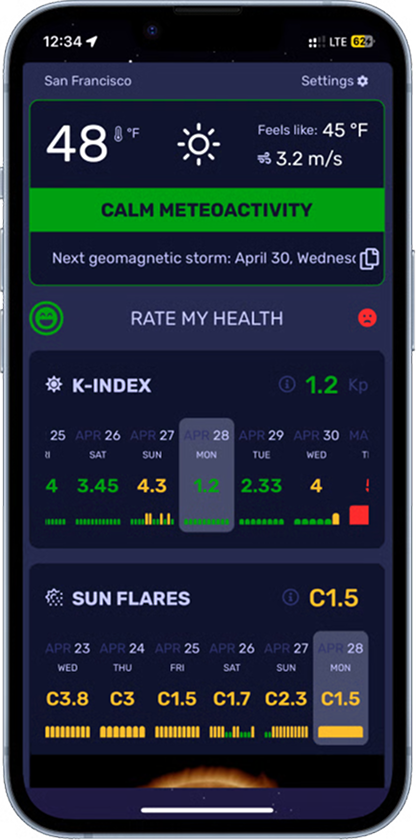
Yes. If you use a wearable that tracks HRV, comparing your daily readings against the Kp index is a practical way to check whether your own data shows a same-day or next-day dip following periods of elevated geomagnetic activity.