

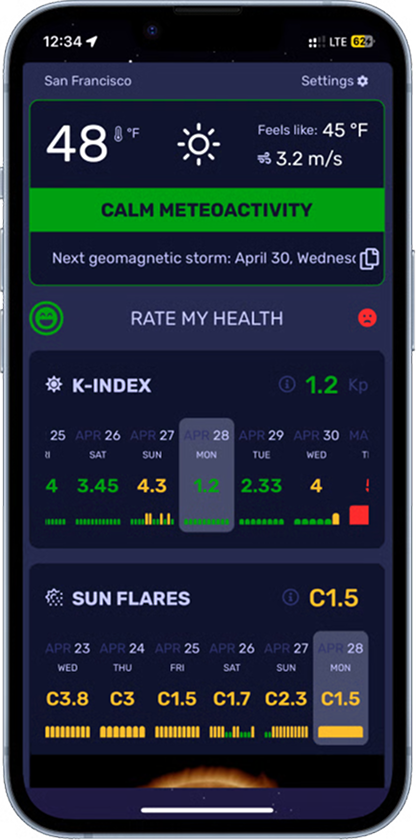


Kp-Index
Every geomagnetic storm entry in this wiki eventually points back to the same number. Kp is the shorthand the entire space weather community has settled on to answer one question — how disturbed is Earth's magnetic field right now — and it's been doing that job, in essentially the same form, since 1932.
What the Kp Index Is
The Kp index (short for planetarische Kennziffer, German for "planetary index") is a global measure of geomagnetic disturbance on a scale from 0 to 9, updated every three hours. It was introduced by German geophysicist Julius Bartels and has been in continuous use long enough to give researchers a nearly century-long record for studying solar cycles and long-term space weather trends.
How It's Actually Calculated
Kp isn't measured directly — it's built up from a specific, deliberately distributed network. Thirteen geomagnetic observatories, positioned between roughly 44° and 60° geomagnetic latitude in both hemispheres, each record a local K-index every three hours, based on how much the horizontal component of the magnetic field deviates from a quiet baseline day at that location.
Here's the detail that matters: raw disturbance thresholds are calibrated per station, because the same actual disturbance produces very different readings depending on latitude. A K=9 reading corresponds to a 1,500 nT deviation in Qeqertarsuaq, Greenland, but only 300 nT in Honolulu and 500 nT in Kiel, Germany — high-latitude locations naturally see larger raw fluctuations. Bartels' original conversion tables standardize each station's K-index into a comparable Ks value, and the Kp index is then the weighted average of all 13 stations' Ks values, expressed in thirds — 5-, 5o, and 5+, for example, representing 4⅔, 5, and 5⅓.
Kp vs. the G-Scale vs. Dst
These three numbers get used almost interchangeably, but they measure slightly different things:
Index What it measures Update frequency
- Kp | Global average magnetic disturbance, standardized across 13 stations | Every 3 hours
- G-scale | NOAA's public-facing translation of Kp into storm severity categories (G1–G5) | Every 3 hours
- Dst | Strength of the equatorial ring current specifically, in nanotesla | Hourly
Kp is the underlying measurement; the G-scale is its plain-language interpretation for public alerts. Dst is a separate, complementary index that tends to track the ring current more directly and go sharply negative during the most intense storms, sometimes revealing storm severity that a 3-hourly Kp snapshot can miss between updates.
The Ap Index: Kp's Linear Cousin
Because Kp's scale is quasi-logarithmic (each step doesn't represent an equal amount of physical disturbance), researchers also use the Ap index — a linear equivalent-amplitude version of the same 3-hour measurements, better suited to statistical and long-term trend analysis where a strictly logarithmic scale would distort averages.
Why Kp Updates Every 3 Hours, Not Continuously
The three-hour cadence isn't a limitation of the technology — it's the interval Bartels originally chose in the 1930s, and it has stuck because it balances responsiveness with the averaging needed to smooth out short-lived local noise. In practice, NOAA's Space Weather Prediction Center publishes a near-real-time estimated Kp throughout each interval, using data from 8 of the 13 official stations, and finalizes the official value once all data is in.
What Kp Levels Actually Mean
Kp value Typical significance
- 0–2 | Quiet; no notable effects
- 3–4 | Unsettled to active; aurora possible at high latitudes
- 5 (G1) | Minor storm; weak grid fluctuations, aurora at high latitudes
- 6 (G2) | Moderate storm; aurora pushes toward mid-high latitudes
- 7 (G3) | Strong storm; intermittent GPS/radio issues
- 8 (G4) | Severe storm; aurora visible at lower latitudes
- 9 (G5) | Extreme storm; widespread grid and satellite impact
Established Effects Tied to Kp
The confirmed, measurable effects of rising Kp — radio disruption, GPS degradation, satellite drag, power grid fluctuations, and aurora at progressively lower latitudes — are covered in full in this wiki's geomagnetic storms entry. Kp is simply the number that determines which of those effects are in play on a given day.
Possible Effects on Human Health
As covered in this wiki's circadian rhythms and meteoropathy entries, some research finds measurable effects on melatonin regulation once geomagnetic activity crosses a real disturbance threshold — one Arctic study put that threshold at roughly 80 nT per 3 hours, which corresponds to Kp levels well into the G2–G3 storm range rather than routine daily fluctuation. That's a useful, concrete way to read the Kp scale if you're tracking your own sensitivity: quiet-to-active days (Kp 0-4) are unlikely to be the driver of how you feel, while sustained Kp 6+ periods are where a real pattern is more plausible to look for.
What is the Kp index?
The Kp index is a global measure of geomagnetic disturbance on a scale from 0 to 9, updated every three hours. It's calculated as a weighted average of standardized readings from 13 geomagnetic observatories positioned around the world.
How is the Kp index calculated?
Each of 13 observatories records a local K-index every three hours based on magnetic field deviation from quiet baseline conditions. These readings are standardized using station-specific conversion tables, then averaged into the single planetary Kp value.
What is the difference between Kp, the G-scale, and Dst?
Kp is the underlying 0-9 measurement of global disturbance. The G-scale is NOAA's plain-language translation of Kp into storm severity categories (G1-G5). Dst measures the ring current's strength specifically, updated hourly, and can reveal detail Kp's 3-hour snapshots miss.
Why does the same Kp value mean different things at different latitudes?
Kp is already standardized to account for this, but the raw local K-index it's built from isn't uniform — the same magnetic disturbance produces a much larger raw reading at high-latitude stations like Greenland than at lower-latitude stations like Hawaii, which is why Bartels' original conversion tables exist.
What Kp value indicates a geomagnetic storm?
A Kp of 5 marks the threshold for a G1 (minor) storm, rising through G2 at Kp 6, G3 at Kp 7, G4 at Kp 8, and G5 (extreme) at Kp 9. Below Kp 5, conditions are considered quiet to active but not storm-level.
Is there a Kp threshold where health effects become more likely?
Some research on melatonin regulation found effects appearing above roughly 80 nT of disturbance per 3 hours, corresponding to Kp levels in the G2-G3 storm range. Below that threshold, studies haven't found a measurable effect.