



Magnetic Field
Earth's Magnetic Field: The Shield Behind Every Geomagnetic Storm
Every geomagnetic storm, every aurora, every Kp-index reading in this wiki describes the same thing happening to the same object: Earth's magnetic field reacting to the Sun. The field itself rarely gets top billing — it's the quiet backdrop everything else plays out against — but it's the reason solar activity produces effects at all, rather than passing Earth by unnoticed.
What Generates Earth's Magnetic Field
About 3,000 kilometers beneath your feet, a churning ocean of molten iron makes up Earth's outer core. As the planet rotates, convection currents in that liquid iron move in organized patterns, generating electric currents the same way a spinning conductor does in a bicycle dynamo. Those currents produce a magnetic field that extends far beyond the planet's surface — this is the geodynamo, and it's been running for most of Earth's history.
The field isn't static. Its strength and shape shift continuously as flow patterns in the core evolve, and its magnetic poles drift independently of the geographic poles — the north magnetic pole has been moving at a notably faster pace over the last few decades.
The Magnetosphere
Earth's magnetic field extends outward into space as the magnetosphere, a region shaped less like a simple bubble and more like a windsock — compressed on the side facing the Sun, stretched into a long tail on the side facing away.
- Bow shock — the outermost boundary, where the supersonic solar wind first slows and deflects around the field, similar to the shock wave in front of a boat's bow.
- Magnetopause — the actual edge of the magnetosphere, where the pressure of the solar wind and Earth's magnetic field balance out. On the sunward side it typically sits around 10 Earth radii out; a strong CME can compress it much closer.
- Magnetotail — a long stretch of magnetic field pulled out behind Earth by the solar wind, sometimes millions of kilometers long.
- Van Allen radiation belts — two doughnut-shaped regions of trapped, high-energy charged particles held in place by the field, an important consideration for satellite and spacecraft design.
How the Field Interacts With the Sun
The solar wind — a continuous stream of charged particles from the Sun — pushes against the magnetosphere at all times, which is why the field is never perfectly still. Most of that pressure gets deflected harmlessly around the planet. But when incoming plasma, especially from a coronal mass ejection, carries a magnetic field oriented opposite to Earth's own, the two fields connect instead of sliding past each other in a process called magnetic reconnection. That connection opens a direct channel for solar wind energy to pour into the magnetosphere — the trigger behind every geomagnetic storm.
Once inside, that energy intensifies the ring current circling the planet and accelerates particles down along field lines toward the poles, where they collide with atmospheric gases and produce the aurora — the magnetic field's most visible signature, and the clearest evidence that a storm is underway.
Established Effects
A disturbed magnetic field induces currents in anything long and conductive on the ground — pipelines, transmission lines — which can trip power grid protections during strong storms. It also reshapes the ionosphere in ways that degrade GPS accuracy and disrupt high-frequency radio. These effects are covered in more detail in this wiki's geomagnetic storms entry, since they're really the storm's effects, expressed through the field.
Possible Effects on Human Health
The same fluctuations that show up as a Kp-index spike are the ones some people report noticing in themselves — disrupted sleep, headaches, fatigue, low mood — during active geomagnetic periods. As with Schumann resonance, correlational research exists on geomagnetic activity and measures like sleep and cardiovascular indicators, but a confirmed mechanism connecting field disturbances directly to symptoms hasn't been established. It remains a real, reported pattern worth tracking personally, without treating it as settled science.
The Field Today: A Shield That's Changing Unevenly
Earth's magnetic field isn't weakening or strengthening uniformly. ESA's Swarm satellite constellation has tracked the South Atlantic Anomaly — a large region of reduced field strength stretching between South America and southern Africa — expanding by roughly half the area of continental Europe since 2014, with an especially fast weakening near southwest Africa tied to unusual flow patterns at the boundary between the core and mantle.
At the same time, field strength has been increasing over parts of Siberia. Satellites passing through the Anomaly experience higher radiation exposure and a greater risk of technical glitches, which is why it's closely monitored, though current data doesn't point to an imminent pole reversal — those events unfold over thousands of years, not within a human lifetime.
At the same time, field strength has been increasing over parts of Siberia. Satellites passing through the Anomaly experience higher radiation exposure and a greater risk of technical glitches, which is why it's closely monitored, though current data doesn't point to an imminent pole reversal — those events unfold over thousands of years, not within a human lifetime.
Tracking the Field's Response
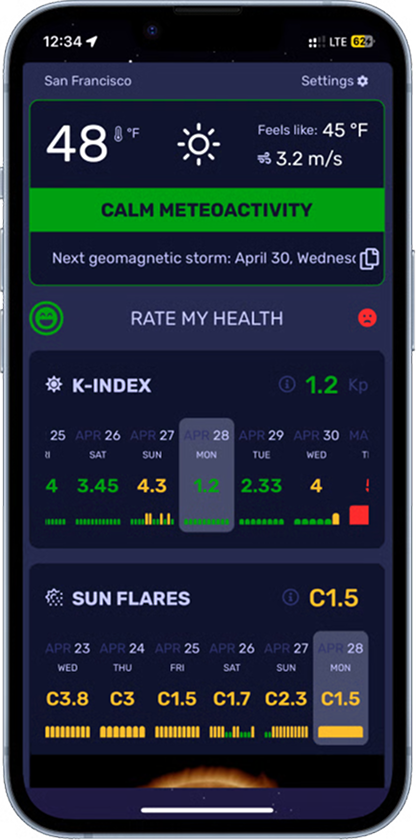
The magnetic field's condition is summarized in real time by the Kp index — the same measurement used throughout this wiki's geomagnetic storm coverage. Meteoagent tracks it alongside solar flare activity and CME arrival estimates, so a disturbance in the field can be traced back to its solar cause and forward to its likely effects.
What causes Earth's magnetic field?
Earth's magnetic field is generated by the geodynamo — convection currents in the molten iron outer core, roughly 3,000 km beneath the surface, that generate electric currents as the planet rotates, similar to a spinning conductor in a bicycle dynamo.
What is the magnetosphere?
The magnetosphere is the region of space shaped by Earth's magnetic field, compressed on the side facing the Sun and stretched into a long magnetotail on the far side. It includes the bow shock, magnetopause, and the Van Allen radiation belts.
How does Earth's magnetic field cause geomagnetic storms?
When solar wind or a coronal mass ejection carries a magnetic field oriented opposite to Earth's, the two fields connect through magnetic reconnection, letting solar wind energy pour into the magnetosphere. This intensifies the ring current and drives geomagnetic storms.
How does the magnetic field create aurora?
During a geomagnetic disturbance, charged particles are accelerated along magnetic field lines toward the poles, where they collide with atmospheric gases and release light — producing the aurora. Stronger disturbances push the visible aurora to lower latitudes.
Is Earth's magnetic field weakening?
Unevenly, yes in some regions. Satellite data shows the South Atlantic Anomaly, a large weak spot in the field, has expanded significantly since 2014, while field strength has increased in other areas like Siberia. This isn't considered a sign of an imminent pole reversal.
Can changes in Earth's magnetic field affect human health?
Many people report symptoms like headaches, fatigue, or disrupted sleep during geomagnetically active periods. Correlational research exists, but a confirmed biological mechanism hasn't been established, making it an area of ongoing study rather than settled fact.