

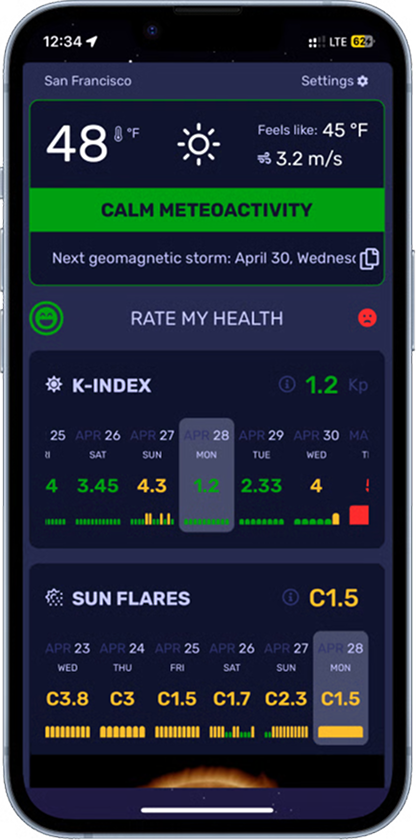


Weather Sensitivity
Some people can tell a storm is coming before the sky changes — a dull ache in an old injury, a headache that starts a day early, a wave of tiredness with no obvious cause. This is weather sensitivity: a widely reported pattern where changes in weather and space weather conditions seem to affect how people feel, even though the mechanisms behind it are still only partly understood.
What Is Weather Sensitivity
Weather sensitivity describes a noticeable change in physical or emotional wellbeing that seems to track with shifts in atmospheric or space weather conditions — most commonly barometric pressure drops, temperature swings, humidity changes, and geomagnetic activity. It isn't one single symptom or one single trigger; it's an umbrella term for a pattern many people recognize in themselves without ever having a name for it.
The scientific term for this pattern is meteoropathy (see our in-depth article on what meteoropathy is for the full clinical picture). Weather sensitivity is the everyday way most people describe the same experience — you don't need a diagnosis to notice that certain kinds of weather consistently coincide with how you feel.
What Triggers Weather Sensitivity
Different people react to different triggers, and often more than one at once:
- Barometric pressure changes — a rapid drop in atmospheric pressure ahead of a storm is one of the most consistently studied triggers, particularly for joint pain and migraine.
- Geomagnetic activity — solar flares and geomagnetic storms are linked, in a growing body of observational research, to changes in heart rate variability, sleep, and mood in sensitive individuals.
- Temperature swings — sudden heat or cold, and rapid day-to-day shifts, can affect blood vessels and blood pressure regulation.
- Humidity — high humidity can affect how the body regulates temperature and can worsen the perception of joint stiffness.
- Schumann resonance fluctuations — a less-studied, more debated possible trigger; the evidence base here is notably thinner than for pressure or geomagnetic activity.
Each of these has its own dedicated page with the specific research behind it — this page is the map, not the deep dive.
Established Effects
- Joint and chronic pain. A number of studies find a statistical association between falling barometric pressure and increased pain reports in people with arthritis and other chronic pain conditions.
- Migraine. Barometric pressure changes are among the most frequently self-reported migraine triggers, and several clinical studies support a real, if modest, association.
- Sleep and circadian rhythm. Temperature and light changes across seasons and weather fronts are established influences on sleep quality and circadian timing.
Possible Effects
- Mood and energy. Many weather-sensitive people report low mood, fatigue, or irritability on days with sharp weather or geomagnetic changes — and, just as often, others report the opposite: a burst of energy or focus. The evidence here is correlational rather than mechanistic.
- Cardiovascular symptoms. Some studies link geomagnetic activity to blood pressure spikes and changes in heart rate variability, though the biological pathway isn't fully established.
- "Brain fog" and concentration. Frequently self-reported, rarely studied in controlled conditions — worth tracking personally rather than treating as confirmed.
As with every topic on this site: if you notice your own wellbeing shifting alongside certain weather patterns, tracking that pattern for yourself is a reasonable and safe thing to do. It's an observation of correlation in your own life, not a diagnosis.
Common Symptoms People Associate with Weather Sensitivity
- Headaches or migraines
- Joint or old-injury pain
- Fatigue that doesn't match your sleep or activity level
- Trouble concentrating
- Low mood or, conversely, restlessness and irritability
- Sleep that feels lighter or more disrupted than usual
Who Tends to Notice It Most
Weather sensitivity is reported more often by people with existing chronic pain conditions (arthritis, fibromyalgia, migraine history), older adults, and people with cardiovascular or autonomic nervous system sensitivities — but plenty of people with no diagnosed condition notice the same pattern. Sensitivity also appears to vary a great deal between individuals, which is part of why it's hard to study with a single controlled experiment.
Living With Weather Sensitivity
- Track your own pattern. Because sensitivity is individual, a personal log of symptoms against pressure, Kp-index, and temperature data is often more useful than general advice.
- Plan lighter days around known triggers. If a pressure drop or geomagnetic storm is forecast, it may be worth building in more rest or fewer demanding commitments.
- Stay hydrated and keep a stable sleep schedule. Both make the body more resilient to the small physiological stresses weather changes bring.
- Talk to a doctor about pain or migraine patterns. If weather-linked pain or migraine is frequent or severe, a clinician can help — weather sensitivity tracking is a complement to medical care, not a substitute for it.
Scientific Publications
- Wang L, Xu Q, Chen Y, Zhu Z, Cao Y (2023). Associations between weather conditions and osteoarthritis pain: a systematic review and meta-analysis. Annals of Medicine — https://pubmed.ncbi.nlm.nih.gov/37078741/
- Timmermans EJ, van der Pas S, Schaap LA, et al. (2014). Self-perceived weather sensitivity and joint pain in older people with osteoarthritis in six European countries: results from the European Project on OSteoArthritis (EPOSA). BMC Musculoskeletal Disorders — https://pubmed.ncbi.nlm.nih.gov/24597710/
- Smedslund G, Hagen KB (2011). Does rain really cause pain? A systematic review of the associations between weather factors and severity of pain in people with rheumatoid arthritis. European Journal of Pain — https://pubmed.ncbi.nlm.nih.gov/20570193/
- Maini K, Schuster NM (2019). Headache and Barometric Pressure: A Narrative Review. Current Pain and Headache Reports — https://pubmed.ncbi.nlm.nih.gov/31707623/
- Farah A, Adam Y, Ahmed O, et al. (2025). Impact of Barometric Pressure Changes on the Severity, Frequency, and Duration of Migraine Attacks: A Systematic Review of the Literature. Cureus — https://www.ncbi.nlm.nih.gov/pmc/articles/PMC12617017/