



Solar Flares
Solar Flares: What They Are and Why the Sun Keeps Erupting
The Sun looks calm from here. Ninety-three million miles of empty space do that — they smooth everything out. But up close, its surface is a churn of magnetic fields twisting, snapping, and releasing energy equivalent to millions of hydrogen bombs in a matter of minutes. That release is a solar flare.
Flares are the fastest, most dramatic form of solar activity, and in 2026 — deep in the maximum of Solar Cycle 25 — they're happening almost daily. Understanding what they are, how they're measured, and what they realistically do and don't mean for Earth is useful for anyone who's seen an alarming headline about them and wants the actual science behind it.
What Is a Solar Flare
A solar flare is a sudden, intense burst of radiation coming from the release of magnetic energy stored in the Sun's atmosphere. It happens above sunspots — regions where the Sun's magnetic field lines get tangled and stressed. When those field lines can't hold the tension anymore, they snap and reconnect in a process called magnetic reconnection, hurling energy outward across the entire electromagnetic spectrum: X-rays, ultraviolet light, radio waves, visible light.
The whole event, from buildup to peak brightness, typically lasts minutes to a few hours. But the light — and the X-rays — reach Earth in about eight minutes, the same time it takes sunlight to arrive on an ordinary day.
How Solar Flares Form
Sunspots are the nurseries. They're darker, cooler patches on the Sun's surface where magnetic field lines poke through and loop back into the interior. The more complex and twisted a sunspot's magnetic structure, the more likely it is to flare.
Active regions with mixed magnetic polarity — north and south poles crowded close together — are the ones to watch. In early 2026, a single active region (numbered 4366 by NOAA) became what forecasters started calling a "flare factory," producing dozens of C- and M-class flares and several X-class events within days. That's the pattern during solar maximum: a handful of hyperactive regions doing most of the work.
Flare Classification: A, B, C, M, X
Flares are ranked by the peak X-ray flux they produce, measured in watts per square meter. The scale is logarithmic, so each letter represents a tenfold jump in energy over the last.
Class Peak X-ray flux (W/m²) What it means
- A, B | Background level | No noticeable effect on Earth
- C | 10⁻⁶ to 10⁻⁵ | Minor, usually unnoticed outside of instruments
- M | 10⁻⁵ to 10⁻⁴ | Brief radio blackouts near the poles, minor radiation storms
- X | 10⁻⁴ and above | Strongest category; can cause planet-wide radio blackouts
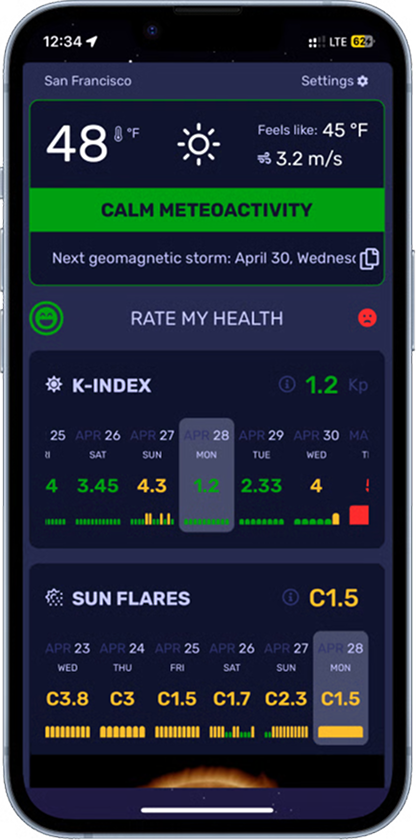
Within each letter, a number from 1 to 9 fine-tunes the strength — an M5 flare is five times stronger than an M1. X-class flares don't cap at 9; the strongest on record, in 2003, overloaded the measuring instrument and is estimated at X45 or higher. The largest of Solar Cycle 25 so far was an X9.0 on October 3, 2024.
Solar Flares vs. Coronal Mass Ejections
The two are often mentioned together — and blamed for each other's effects — but they're not the same thing. A flare is a flash of radiation: pure light and X-rays, arriving in about 8 minutes, with no physical mass involved. A coronal mass ejection (CME) is a separate event: a genuine eruption of billions of tons of magnetized plasma physically launched from the Sun's corona, arriving at Earth over one to three days.
This distinction matters more than it might seem, because most of the effects people worry about — power grid stress, satellite disruption, strong aurora — actually come from the CME and the geomagnetic storm it can trigger, not from the flare's radiation itself. Big flares are frequently, but not always, accompanied by a CME; when they travel together and both point at Earth, that's when the strongest storms and the most vivid auroras tend to follow. A powerful flare with no associated Earth-directed CME can produce a dramatic radio blackout and then simply pass, with no further effect.
How Solar Flares Affect Earth
Because flare radiation arrives almost instantly, its effects show up fast, mainly on the sunlit side of the planet:
- Radio blackouts. X-rays and extreme ultraviolet light ionize the upper atmosphere, disrupting high-frequency radio communication — the kind used by aviation, maritime, and amateur radio operators.
- GPS and satellite signal degradation. Increased ionization can distort the signals GPS systems depend on for precision.
- No direct danger at ground level. Earth's atmosphere and magnetic field absorb the harmful radiation before it reaches the surface. The people most exposed are astronauts and passengers on high-altitude polar flights.
- Indirect effects through associated CMEs and geomagnetic storms. This is where auroras, satellite drag, and power grid fluctuations come in.
Could a Solar Flare Hurt You Directly?
This is worth answering plainly: no. A solar flare's X-rays and ultraviolet radiation are absorbed by Earth's atmosphere long before they reach ground level — that absorption is exactly what causes the ionospheric disturbances behind radio blackouts. There's no physical pathway for a flare, on its own, to make you sick, tired, foggy, or unwell. Solar flares don't cause earthquakes either; no seismologist has found a credible mechanism connecting solar activity to seismic events, despite the claim circulating periodically online.
Where the health questions become genuinely more interesting is with geomagnetic storms — the disturbance that sometimes follows a day or two after a flare, once an associated CME arrives and connects with Earth's magnetic field. Many people report headaches, fatigue, disrupted sleep, or feeling generally "off" during active geomagnetic periods, and there's real, if still-developing, research into that connection, covered in this wiki's entries on geomagnetic storms, meteoropathy, heart rate variability, and circadian rhythms. The practical distinction: a flare itself won't touch you; what might is the storm arriving a day or two later, if one comes at all.
The Carrington Event: What a Worst-Case Flare Actually Looked Like
Every question about "how bad could this get" eventually leads back to one historical benchmark. On September 1, 1859, astronomer Richard Carrington observed an intense white-light solar flare lasting about five minutes. The associated CME reached Earth in roughly 18 hours — unusually fast — and triggered the strongest geomagnetic storm in the historical record, with effects (telegraph failures, aurora visible near the equator) unfolding over about two days.
It's the standard reference point for worst-case planning not because it was uniquely dangerous in a way modern events couldn't match, but because it's the most intense event with direct historical documentation. This wiki's dedicated Carrington Event entry covers the full history, how its intensity was measured retroactively, and how it compares to modern storms in detail.
Could a Carrington-Level Event Happen Again and Could It End Humanity?
Almost certainly not the second part, and here's why that's a reasonably confident answer rather than just reassurance: the physical mechanism behind geomagnetic storm damage — induced electrical currents stressing power grids and electronics — is well understood, and even the 1859 event's effects, while serious for the technology of the time, were survivable and left no lasting global damage. Nothing in known solar physics points to a flare or CME capable of an extinction-level or civilization-ending event; the Sun's flares, however large, don't have a mechanism to directly harm the atmosphere, oceans, or the planet's basic habitability.
The more serious, honest answer is about infrastructure, not survival. A Carrington-class event today would stress modern power grids and satellite systems far beyond anything experienced in the satellite era, and because that hasn't actually happened since electrification, the precise scale of disruption is genuinely uncertain rather than fully modeled. Some risk assessments, including a widely cited 2013 Lloyd's of London report, estimated potential outages lasting months in the worst-affected areas, given how long large replacement transformers can take to manufacture and install — a real, worth-planning-for scenario, but a recovery timeline measured in months to a couple of years for the hardest-hit regions, not the collapse of civilization.
As for likelihood: estimates for another Carrington-class storm vary considerably by statistical model, from roughly 0.5% to 12% per decade — a genuinely wide range that reflects how difficult it is to estimate rare extreme events from a limited data record, covered in more depth in this wiki's Carrington Event entry.
What Was Supposed to Happen on July 23, 2012?
Nothing happened to Earth — because the event in question missed. On July 23, 2012, the Sun produced a coronal mass ejection comparable in speed and scale to the Carrington Event, measured by NASA's STEREO-A spacecraft at over 2,000 km/s. It crossed Earth's orbital path but arrived when Earth itself was about a week away from that point in its orbit — a near-miss, not an unrealized catastrophe. Some later commentary framed it as something that was "prevented" or narrowly avoided through luck rather than physics, which overstates it slightly: it's more accurate to say it demonstrated that Carrington-scale eruptions do still occur in the modern era, and this particular one simply wasn't aimed at Earth at the time.
Has a Solar Flare Ever Actually Reached Earth
In the literal sense, constantly — every flare's light and X-rays reach Earth about 8 minutes after the eruption, which is how they're observed and classified in the first place. In the sense of a historically significant, strongly Earth-effecting event: yes, repeatedly, including the 1859 Carrington Event, an 1859-scale event is estimated to occur roughly once per century to few centuries based on historical and ice-core proxy records, and, more recently, the X9.0 flare of October 3, 2024, the largest of the current solar cycle, along with the CME-driven May 2024 "Gannon" geomagnetic storm — the strongest since 2003, though notably weaker than Carrington-level intensity.
Is a Solar Flare Going to Hit Earth in 2026?
In the sense of ordinary flares reaching Earth: yes, essentially continuously — Solar Cycle 25's extended maximum has kept flares, including X-class events, arriving on a near-daily basis through 2026, and this is normal, expected behavior for this phase of the solar cycle rather than a special or unusual occurrence. In the sense of a Carrington-scale extreme event: there's no way to predict a specific date for that in advance, and nothing currently observed on the Sun points to one being imminent; forecasters track active regions and issue watches only a few days out at most, using real-time monitoring rather than long-range prediction.
Will 2026 Be the Peak of Solar Cycle 25?
The cycle's confirmed maximum phase began in October 2024, and that phase — rather than a single peak day — has continued well into 2026, partly because solar maximum can show two separate peaks as the Sun's northern and southern hemispheres crest at slightly different times. Whether 2026 specifically turns out to be the single strongest year won't be fully clear until the cycle's activity is reviewed in hindsight, but the cycle remains solidly in its active, elevated phase through this year regardless.
What Will Happen to the Sun in 2030?
Nothing dramatic to the Sun itself, 2030 is simply the rough timeframe when Solar Cycle 25 is expected to decline toward its next solar minimum, the quieter phase of the roughly 11-year cycle, before Cycle 26 begins its own rise. This is normal, expected stellar behavior the Sun has repeated for billions of years, not a sign of any unusual change. This wiki's Solar Cycle entry covers how that longer rhythm works and why cycle strength is genuinely difficult to predict far in advance.
Solar Cycle 25 and Why 2026 Is So Active
The Sun runs on a roughly 11-year rhythm, swinging between quiet solar minimum and stormy solar maximum. Solar Cycle 25 began in December 2019, and NASA and NOAA confirmed in October 2024 that it had entered its maximum phase — arriving stronger and earlier than most 2019 forecasts expected. That maximum phase has stayed active well into 2026 rather than tapering off quickly, which is why flare activity has remained high enough to prompt public attention and, inevitably, some of the more alarming search questions this section addresses.
What happens to Earth when a solar flare hits?
A flare's X-rays and ultraviolet radiation ionize Earth's upper atmosphere within minutes, which can disrupt high-frequency radio communication and slightly degrade GPS accuracy. The radiation itself is absorbed by the atmosphere and never reaches the ground.
Could humans survive a solar flare?
Yes, easily. Earth's atmosphere and magnetic field block the harmful radiation from a solar flare before it reaches ground level. There is no known physical mechanism by which a flare could directly endanger human life at Earth's surface.
Is a solar flare going to hit Earth in 2026?
Ordinary flares are reaching Earth essentially every day in 2026, since the Sun is in the extended maximum phase of Solar Cycle 25. This is normal, expected solar behavior, not a special or dangerous occurrence.
How long would it take for humanity to recover from a solar flare?
A typical flare has no lasting effect to recover from. For a hypothetical Carrington-class extreme event, risk assessments like a 2013 Lloyd's of London report estimate outages in the worst-affected areas could last months, mainly due to how long replacement power transformers take to build, not a civilization-scale collapse.
What was supposed to happen on July 23, 2012?
Nothing happened to Earth, because the Carrington-scale coronal mass ejection observed that day missed the planet, crossing Earth's orbital path about a week before Earth itself arrived at that point. It demonstrated such eruptions still occur, not that a disaster was narrowly avoided by intervention.
Could a solar storm shut down Earth?
No credible mechanism exists for a solar storm to "shut down" the planet. The realistic risk from an extreme, Carrington-class event is regional to widespread power grid and satellite disruption lasting weeks to months, not a global shutdown or extinction-level event.
How bad would a Carrington event be today?
Because no event this strong has occurred during the modern power-grid era, the precise scale is genuinely uncertain, but the established mechanism (induced currents stressing transformers and grid equipment) would likely cause more serious and widespread outages than the 1989 Quebec blackout, with recovery in the hardest-hit areas potentially taking months.
What was the worst solar flare in history?
The most intense flare directly measured by instruments occurred in 2003 and overloaded the measuring sensor, estimated at X45 or higher. The 1859 Carrington Event produced a less extreme flare but the strongest geomagnetic storm in the historical record, due to its unusually fast, well-aimed coronal mass ejection.
Could a solar flare end humanity?
No. Nothing in known solar physics gives a flare or CME a mechanism to threaten the atmosphere, oceans, or basic habitability of the planet. The realistic worst-case risk is serious, temporary disruption to power grids and satellites, not an extinction-level event.
Has a solar flare ever reached Earth?
Every solar flare's light and X-rays reach Earth about 8 minutes after eruption, which is how they're observed at all. Major, strongly Earth-effecting events include the 1859 Carrington Event and, more recently, the X9.0 flare of October 3, 2024.
Could a Carrington Event happen again?
Yes, in principle — the Sun remains capable of producing eruptions of that scale, as the July 2012 near-miss demonstrated. Statistical estimates for the likelihood of another Carrington-class event range widely, from roughly 0.5% to 12% per decade, depending on the model used.
How long did the 1859 solar flare last?
The white-light flare Richard Carrington observed lasted about five minutes. The resulting geomagnetic storm effects at Earth, including telegraph disruptions and widespread aurora, unfolded over roughly two days after the associated CME arrived.
What if the 1859 Carrington Event happened today?
The established mechanism — geomagnetically induced currents stressing power grids and satellites — would cause more disruption than any storm since, given how much more electronic infrastructure now exists. The exact modern-day scale of impact remains genuinely uncertain, since no event this strong has occurred during the power-grid era.
What happened to Earth in 1859?
A coronal mass ejection following an intense solar flare triggered the strongest geomagnetic storm in the historical record. Telegraph systems across Europe and North America failed, some equipment sparked or caught fire, and aurora was visible as far south as Cuba and Hawaii.
What if a CME hits Earth?
Depending on its speed, mass, and magnetic orientation on arrival, a CME can trigger a geomagnetic storm ranging from a minor G1 event with limited effects to a severe G4-G5 storm affecting power grids, satellites, GPS, and radio communication, along with aurora visible at unusually low latitudes.
Is there a solar flare going to hit Earth?
Flares are reaching Earth on a near-daily basis during this active phase of Solar Cycle 25. Most are minor and have no noticeable effect; larger X-class events can cause temporary radio blackouts, and are tracked in real time by monitoring agencies like NOAA.
Will 2026 be the peak of Solar Cycle 25?
Solar Cycle 25's confirmed maximum phase began in October 2024 and has continued through 2026, partly due to a double-peak pattern between the Sun's hemispheres. Whether 2026 is the single strongest year will only be clear in later review of the full activity record.
Do solar flares affect human beings?
Not directly — a flare's radiation is absorbed by Earth's atmosphere before reaching the ground. Reported effects like fatigue or headaches are more often associated with the geomagnetic storms that sometimes follow a day or two later, an area of ongoing research covered elsewhere in this wiki.
Do solar flares make you feel sick or tired?
A flare itself has no known mechanism to cause these symptoms, since its radiation doesn't reach the ground. Symptoms some people report are more consistently associated with the geomagnetic storms that can follow a CME's arrival, not the flare itself.
Do solar flares affect the brain?
There's no established mechanism for a flare's radiation to directly affect the brain, since it's absorbed by the atmosphere. Research into geomagnetic activity's effects on the nervous system, including circadian rhythms and heart rate variability, is a separate, ongoing area covered elsewhere in this wiki.
Do solar flares cause earthquakes?
No credible scientific mechanism links solar flares to earthquakes, and no seismological research has established such a connection, despite the claim appearing periodically online.
Can a geomagnetic storm make you feel weird?
Many people report symptoms like fatigue, headaches, or disrupted sleep during geomagnetically active periods, and there's genuine, if still-developing, research into a possible connection. It's a real, widely reported pattern without yet a fully confirmed biological mechanism.