



Sun
The Sun: The Source Behind Every Space Weather Event
Everything in this wiki — flares, geomagnetic storms, Schumann resonance spikes, aurora — traces back to one object 93 million miles away. The Sun isn't a static ball of light. It's a churning, magnetically restless star, and nearly everything that reaches Earth as "space weather" started as a disturbance on its surface hours, days, or sometimes only minutes earlier.
What the Sun Is
The Sun is a massive sphere of plasma, held together by its own gravity and powered by nuclear fusion at its core, where hydrogen converts to helium at temperatures near 15 million °C. That energy works its way outward through several distinct layers:
- Core — where fusion happens.
- Radiative zone — energy slowly diffuses outward as radiation, a journey that can take hundreds of thousands of years.
- Convective zone — hot plasma physically rises and falls, carrying energy the rest of the way, like water boiling in a pot.
- Photosphere — the visible "surface," about 5,500°C, where sunspots appear as darker, cooler patches.
- Chromosphere and corona — the outer atmosphere, far hotter than the surface below it (the corona reaches over a million degrees, a long-standing puzzle in solar physics), and the layer from which flares and coronal mass ejections erupt.
The Sun's Magnetic Engine
The Sun doesn't rotate as a solid body — its equator spins faster than its poles, a behavior called differential rotation. Over time, this twists and stretches the Sun's magnetic field lines into increasingly tangled configurations. Where those field lines break through the photosphere, they suppress the normal flow of heat, creating the cooler, darker regions known as sunspots.
The most magnetically complex sunspot groups — active regions with tightly mixed magnetic polarities — are where flares and CMEs originate. Solar activity rises and falls on an approximately 11-year cycle as this magnetic tangle builds toward a maximum, then resets. The current cycle, Solar Cycle 25, began in December 2019 and was confirmed to have entered its maximum phase in October 2024 — a phase that, in 2026, is still producing frequent X-class flares and Earth-directed CMEs from a rotating cast of active regions.
From the Sun to Earth: Three Different Timelines
Solar activity doesn't arrive all at once — different phenomena travel at different speeds, which is why space weather forecasting is really about tracking several separate clocks:
Phenomenon Travel time to Earth What it affects
- | Solar flare (light, X-rays) | ~8 minutes | Radio blackouts, GPS signal quality
- | Coronal mass ejection (CME) | 1–3 days | Geomagnetic storms, aurora, power grids
- | Solar wind / coronal hole streams | 2–4 days | Milder, recurring geomagnetic activity
A flare arrives almost the instant it's observed. A CME launched in the same eruption gives a real window of advance warning before any geomagnetic effects show up on Earth — which is the main reason storms are more forecastable than flares themselves.
Established Effects
Once solar activity reaches Earth, its confirmed, measured effects include disrupted high-frequency radio communication, degraded GPS accuracy, increased drag on low-orbit satellites, and — during the strongest geomagnetic storms — induced currents capable of tripping power grid protections. These are covered in detail in the solar flares and geomagnetic storms entries in this wiki.
Possible Effects on Human Health
This is the layer of the topic science is still actively working through. Many people who describe themselves as sensitive to weather or geomagnetic conditions report headaches, fatigue, disrupted sleep, or low mood clustering around solar flares, geomagnetic storms, and Schumann resonance amplitude spikes. Some correlational research supports an association between geomagnetic activity and measures like sleep quality, blood pressure, or mood; a confirmed biological mechanism explaining why remains an open question.
The practical approach: treat the Sun's activity as a real, measurable input — like barometric pressure or humidity — worth checking against your own patterns, without needing a settled mechanism to justify paying attention to how you feel.
The Sun in 2026
Solar Cycle 25 has stayed unusually active well past its original October 2024 peak, consistent with the double-peak pattern seen in past cycles as the Sun's two hemispheres crest at slightly different times. Recent weeks alone have brought a stream of X-class flares — including an X1.1 from active region AR4479 in late June and an X1.3 on July 4 — each paired with an Earth-directed CME and a resulting round of G1–G2 geomagnetic storm watches. NASA and NOAA continue tracking multiple active regions simultaneously, which is why quiet stretches between events have been short.
Tracking the Sun
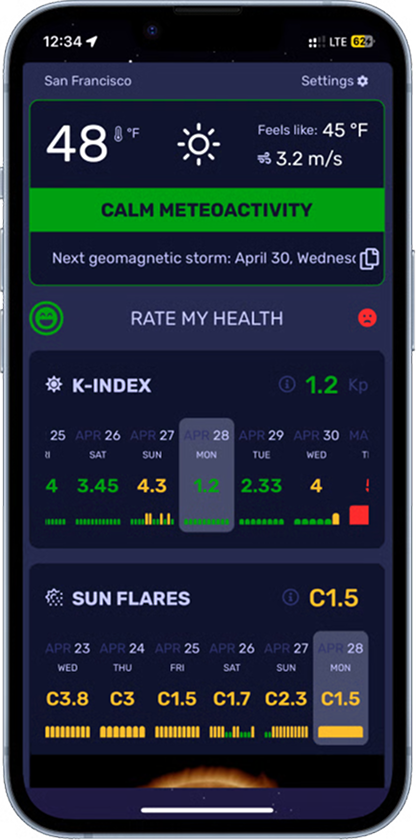
Because flares, CMEs, and solar wind streams all move on different timelines, the most useful way to follow solar activity is to watch them together rather than in isolation. Meteoagent tracks live X-ray flux, active sunspot regions, incoming CME estimates, and the resulting Kp forecast side by side, so a flare on the Sun today can be followed through to whatever it might mean for Earth over the following days.
What is the Sun made of?
The Sun is a sphere of plasma powered by nuclear fusion at its core, where hydrogen converts to helium at around 15 million °C. That energy travels outward through the radiative and convective zones before reaching the visible photosphere and the much hotter outer chromosphere and corona.
What causes solar flares and sunspots?
The Sun's faster-spinning equator twists its magnetic field lines over time, and where the most tangled field lines break through the surface, they form sunspots. The most magnetically complex sunspot groups are where solar flares and coronal mass ejections originate.
How long does it take solar activity to reach Earth?
A solar flare's light and X-rays arrive in about 8 minutes. A coronal mass ejection takes 1-3 days. Solar wind streams from coronal holes typically take 2-4 days, giving useful advance warning before any geomagnetic effects occur.
What is the solar cycle and where are we in it now?
The solar cycle is an roughly 11-year swing between quiet and active phases of the Sun's magnetic activity. The current cycle, Solar Cycle 25, entered its maximum phase in October 2024 and, as of 2026, continues producing frequent X-class flares and geomagnetic storms.
Can solar activity affect human health?
Many people report headaches, fatigue, sleep disruption, or mood changes during periods of high solar and geomagnetic activity. Some correlational studies support a link, but a confirmed biological mechanism hasn't been established, making this an area of ongoing research rather than settled fact.
What's the difference between a solar flare and a coronal mass ejection?
A solar flare is a flash of radiation reaching Earth in minutes. A coronal mass ejection is a separate eruption of solar plasma that takes one to three days to arrive and is the main driver of geomagnetic storms and aurora.