



Geomagnetic Storms
Geomagnetic Storms: When the Sun Rattles Earth's Magnetic Field
Earth's magnetic field is usually a quiet, invisible shield — the reason a compass points north, the reason cosmic radiation doesn't reach the ground. Most days it barely moves. Then a cloud of solar plasma slams into it, and for a day or two, that shield rings like a struck bell. That's a geomagnetic storm.
These storms are the main way solar activity reaches from the Sun's surface all the way down to power grids, GPS receivers, and — many people report — how they sleep and feel. In the middle of Solar Cycle 25's maximum, they've become a near-weekly occurrence, which is exactly why the questions people search about them tend to run from the practical ("is it safe to go outside tonight") to the historical ("how bad has this ever actually gotten"). Both deserve a straight answer, and both are covered here.
What Is a Geomagnetic Storm
A geomagnetic storm is a temporary disturbance of Earth's magnetosphere caused by an efficient transfer of energy from the solar wind into the space environment surrounding Earth. In practice, it happens when a burst of solar plasma — usually a coronal mass ejection (CME), sometimes a fast solar wind stream from a coronal hole — collides with Earth's magnetic field and compresses it.
If that incoming plasma carries a magnetic field oriented opposite to Earth's own (pointing south instead of north), it connects with Earth's field instead of sliding past it. That connection lets energy pour into the magnetosphere, driving electric currents through the upper atmosphere and intensifying the ring current that circles the planet at the equator.
What Causes Geomagnetic Storms
Two solar phenomena do almost all of the work. Coronal mass ejections — billion-ton clouds of magnetized plasma, often following a large solar flare — take one to three days to cross the 93 million miles to Earth, a far longer trip than the flare's own radiation, which arrives in about eight minutes and doesn't itself cause a storm. The second source is corotating interaction regions: fast solar wind streaming from coronal holes that catches up to slower wind ahead of it, creating turbulent, compressed regions that can spark moderate storms on a recurring, roughly 27-day schedule as the same coronal hole rotates back into view.
Occasionally a CME's journey gets more complicated than a single clean eruption. When the Sun launches a second, faster CME shortly after a first, slower one, the faster ejection can catch up mid-flight and physically overtake it — merging the two into a single, denser structure with a more tangled, less predictable magnetic field, an event forecasters call a "cannibal" CME. Because the merged structure carries more combined mass and magnetic energy than either eruption alone, cannibal CMEs tend to produce stronger, harder-to-forecast storms than a typical single-source event; a cannibal CME in June 2026, born from sunspot region AR4461, drove a G3 storm with aurora as far south as northern France, and a similar merger involving three separate CMEs from AR3664 helped fuel the severe G4-G5 conditions of the May 2024 superstorm.
How Storms Are Measured: The Kp Index and G-Scale
Storm strength is tracked with the planetary Kp index, a number from 0 to 9 built from magnetometer readings at stations around the world, updated every three hours. NOAA translates it into a public-facing G-scale:
Kp value G-scale Description
- 5 | G1 – Minor | Weak power grid fluctuations, aurora visible at high latitudes
- 6 | G2 – Moderate | Voltage alarms possible, aurora pushes toward mid-high latitudes
- 7 | G3 – Strong | Intermittent GPS and radio issues, aurora visible mid-latitudes
- 8 | G4 – Severe | Possible grid voltage control problems, aurora visible at lower latitudes
- 9 | G5 – Extreme | Widespread voltage control and protection issues, aurora visible near the equator
How often each level shows up depends heavily on where the solar cycle stands. G1 storms are common during an active cycle — arriving anywhere from weekly to several times a month. G3 events happen a handful of times a year. G4 storms are genuinely uncommon: NOAA counted only three during the first four years of Solar Cycle 25, with the most recent well before that occurring in March 2024. G5 storms are rarer still — before the May 2024 "Gannon" event, the last one on record was the October 2003 "Halloween Storm," meaning more than two decades passed between G5-level events.
The Anatomy of a Storm
Storms unfold in three phases, and together they answer the practical question of how long any given storm actually lasts. A sudden commencement marks the moment the CME's shock front hits Earth's magnetic field, often visible as a sharp jump in magnetometer readings within minutes. A main phase follows, as the ring current intensifies and the Kp index climbs — typically lasting several hours to about a day. Then a recovery phase gradually brings the ring current back down and conditions back to normal, usually spanning one to several days. Added together, a single storm event, start to finish, most often runs its full course within one to three days, though its visible effects — aurora, in particular — are usually concentrated in the narrower window around the main phase and the early part of recovery, often a single night or two.
Effects on Earth
Once a storm is underway, its confirmed effects fall into a few categories. Rapid magnetic field changes induce currents in long transmission lines, which can trip protective relays and, in extreme cases, damage transformers. Increased atmospheric drag can pull low-orbit satellites off course, while ionospheric disturbances distort GPS signal timing. High-frequency radio can fade or black out entirely at high latitudes during strong storms. And the most visible effect — aurora — appears as charged particles funnel along magnetic field lines and excite atmospheric gases into glowing curtains of green, red, and purple, visible far outside the polar regions during strong events; the May 2024 storm pushed aurora as far south as Puerto Rico and northern Mexico.
For the general public standing outside, none of this translates into a direct physical danger. Unlike a solar radiation storm — a separate, much rarer type of event involving energetic particles that primarily concerns astronauts and high-altitude polar flight crews — an ordinary geomagnetic storm carries no radiation exposure at ground level; Earth's atmosphere and magnetic field continue doing their usual job regardless of how active the storm is.
There's no established human sense organ for detecting magnetic fields directly the way migratory birds are believed to, so nobody feels a geomagnetic storm the way they'd feel wind or rain — any sensation people report isn't a direct physical "feeling" of the magnetic disturbance itself, but rather the downstream symptoms discussed next.
Why Some People Notice More Than Others
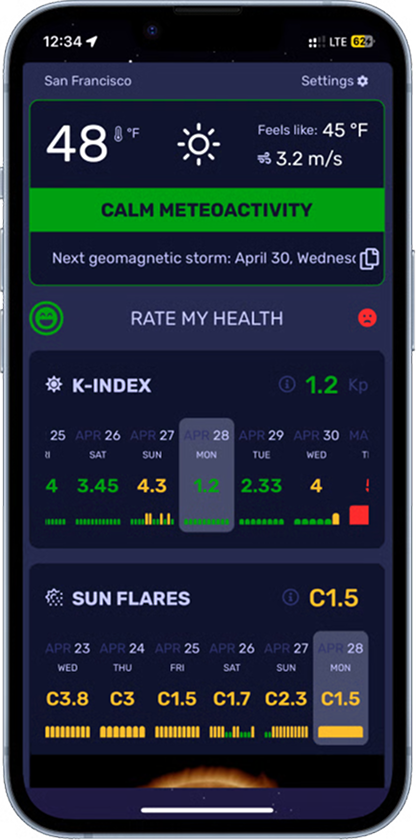
Many people report disrupted sleep, headaches, fatigue, or mood shifts during active geomagnetic periods, and research on the mechanism is still developing — but the correlation is consistently reported enough that tracking daily Kp alongside how you feel is a reasonable, low-effort way to look for a pattern in your own case.
Sensitivity isn't evenly distributed: it tends to cluster in people who already have cardiovascular conditions, migraine, or other chronic sensitivity patterns, echoing the same individual-threshold pattern seen with barometric-pressure sensitivity elsewhere in this wiki, rather than reflecting anything mystical or universal about the experience. That's a separate, more grounded answer to "am I imagining this" than either dismissing it outright or treating it as a given for everyone.
Sensitivity isn't evenly distributed: it tends to cluster in people who already have cardiovascular conditions, migraine, or other chronic sensitivity patterns, echoing the same individual-threshold pattern seen with barometric-pressure sensitivity elsewhere in this wiki, rather than reflecting anything mystical or universal about the experience. That's a separate, more grounded answer to "am I imagining this" than either dismissing it outright or treating it as a given for everyone.
A Reference Point: How Bad Has It Actually Gotten
For genuine historical scale, the 1859 Carrington Event remains the largest geomagnetic storm ever recorded — reconstructed from proxy data and historical magnetometer readings at somewhere between roughly -900 and -1,750 nT on the Dst index, depending on the estimation method, more than twice as intense as anything measured since. This wiki's dedicated Carrington Event entry covers that history in full, including honest uncertainty about how a repeat would play out with today's infrastructure.
Within the era of direct, continuous Dst measurement (which began in 1957), the record holder is the March 1989 storm, which reached -589 nT and collapsed Hydro-Québec's power grid for about nine hours, leaving 6 million people without power. The October–November 2003 "Halloween Storms" reached -422 nT and produced the most recent G5-level event before 2024, with aurora visible as far as California and the Mediterranean.
Between May 7 and 11, 2024, active region AR3664 produced eight X-class flares and a rapid sequence of CMEs — some of which merged en route — resulting in a G5 storm, the strongest since 2003, with a Kp index that touched 9 twice and aurora visible across most of the United States, southern Europe, and parts of South America and southern Africa. None of these, notably, caused anything close to a societal collapse; the practical impact even at G5 intensity has consistently been measured in temporary outages and equipment damage, not lasting catastrophe.
Why Storms Are Frequent Right Now
Solar Cycle 25 entered its maximum phase in late 2024, and that phase, unlike a single peak day, can stretch across a year or more, sometimes with two separate crests as the Sun's hemispheres peak at different times. More active regions on the Sun means more CMEs launched toward Earth, and 2026 has continued producing storms, including the occasional cannibal CME, at a pace well above the quieter years earlier in the cycle.
What is a geomagnetic storm?
A geomagnetic storm is a temporary disturbance of Earth's magnetic field caused by solar wind or a coronal mass ejection colliding with the magnetosphere. It intensifies electric currents in the upper atmosphere and around the planet, producing effects from aurora to power grid fluctuations.
What causes a geomagnetic storm?
Most storms are triggered by a coronal mass ejection reaching Earth one to three days after launch, or by fast solar wind streaming from a coronal hole. Occasionally two CMEs merge in transit into a "cannibal" CME, producing a stronger, less predictable storm than either would alone.
How long does a geomagnetic storm last?
A typical storm runs its full course over one to three days: a sudden commencement within minutes of impact, a main phase of several hours to about a day, and a recovery phase of one to several days. Visible effects like aurora are usually concentrated in a narrower window of a night or two.
How often do geomagnetic storms happen?
It depends on the level. Minor G1 storms occur weekly to several times a month during an active solar cycle, G3 storms happen a handful of times a year, G4 storms are uncommon (only a few per solar cycle), and G5 storms are rare — more than two decades passed between the October 2003 and May 2024 events.
Is it safe to be outside during a geomagnetic storm?
Yes. An ordinary geomagnetic storm carries no radiation exposure at ground level; Earth's atmosphere and magnetic field continue to shield the surface regardless of storm intensity. This is different from a solar radiation storm, a separate event type mainly relevant to astronauts and polar flight crews.
Can you physically feel a geomagnetic storm?
Not directly — there's no established human sense organ for detecting magnetic fields the way some migratory animals are believed to have. Reported symptoms like fatigue or headaches during storms are downstream effects under active research, not a direct physical sensation of the magnetic disturbance itself.
What was the largest geomagnetic storm in history?
The 1859 Carrington Event remains the largest on record, estimated between roughly -900 and -1,750 nT on the Dst index. Within the era of continuous instrument measurement since 1957, the record is the March 1989 storm at -589 nT, which collapsed Quebec's power grid.
Why are some people more sensitive to geomagnetic storms than others?
Reported sensitivity tends to cluster in people with existing cardiovascular conditions, migraine, or other chronic sensitivity patterns, similar to how barometric-pressure sensitivity varies by individual. The underlying mechanism is still being researched, but the pattern of uneven sensitivity is consistently reported.