



Circadian Rhythms
Every cell in your body runs on a roughly 24-hour schedule, kept in sync primarily by one thing: light hitting your eyes. That's the textbook story of the circadian rhythm, and it's correct as far as it goes. But for decades, a smaller line of research has been asking an odder question — whether Earth's magnetic field, quietly fluctuating day and night regardless of whether the Sun is up, might act as a second, much subtler clock setter alongside light.
What Circadian Rhythms Are
The circadian rhythm is the internal 24-hour cycle that governs sleep and wakefulness, body temperature, hormone release, and even gene expression, orchestrated by a small cluster of neurons in the brain called the suprachiasmatic nucleus (SCN). Light is the dominant synchronizing cue, or zeitgeber — it's why jet lag happens and why bright morning light is the standard fix for it. The SCN passes its timing signal to the pineal gland, which releases melatonin as darkness falls, the hormone most directly responsible for making you feel sleepy on schedule.
Is Earth's Magnetic Field a Secondary Zeitgeber?
Earth's geomagnetic field has its own quiet daily rhythm — it fluctuates in predictable patterns tied to Earth's rotation, on top of the larger disturbances caused by solar activity. Researchers studying this proposed that organisms might read those fluctuations as a secondary timing signal, working alongside light rather than instead of it. Early support came from an unexpected place: house sparrows kept in constant light still showed circadian activity patterns that synchronized to an artificially cycled magnetic field, suggesting animals can, in principle, use geomagnetic variation as a clock cue.
What the Human Research Shows
Two studies stand out. In Alta, Norway — above the Arctic Circle, where the sun doesn't rise for weeks each winter and geomagnetic disturbances are unusually strong — researchers tracked melatonin in saliva samples over day-night cycles and found that geomagnetic activity needed to cross a threshold of roughly 80 nanotesla per three hours before it significantly reduced melatonin levels. Below that threshold, no measurable effect appeared, which is a meaningfully high bar — well into moderate-to-strong storm territory, not a response to ordinary background fluctuation.
A separate study of electric utility workers found that elevated geomagnetic activity was associated with lower overnight excretion of a melatonin metabolite, with the strongest effect appearing when the geomagnetic disturbance occurred 15 to 33 hours before the measurement — a window that lines up closely with the body's actual melatonin production and regulation cycle, rather than an arbitrary correlation.
A Possible Mechanism: Cryptochrome
If geomagnetic activity does influence circadian timing, the leading candidate mechanism involves cryptochrome, a light-sensitive protein already known to play a central role in the circadian clock itself. In several animal species, cryptochrome has also been shown to respond to magnetic fields, and researchers have proposed it as a plausible biological sensor linking the two systems — a single protein potentially doing double duty as both a light detector and a magnetic field detector. Whether this holds in exactly the same way in humans is still an open question, but it's a considerably more concrete mechanism than most proposed pathways for space weather sensitivity.
The Opposite Experiment: What Happens With Too Little Field
An unusual angle on this research comes from studying what happens when the geomagnetic field is removed rather than disturbed. Animals kept in near-zero magnetic environments — the kind relevant to long-duration spaceflight — have shown disrupted rhythms in core circadian clock genes and altered noradrenaline activity in the brain. This doesn't prove Earth's field actively drives day-to-day human circadian timing, but it does show that biological systems are demonstrably not indifferent to the presence or absence of a geomagnetic field, which strengthens the case for taking the "field as a subtle input" question seriously.
Where This Connects to the Rest of Space Weather
This is the mechanism most often invoked when people describe poor sleep during geomagnetic storms, and it dovetails with the Schumann resonance entry in this wiki: 7.83 Hz sits near the commonly cited boundary between theta and alpha brainwave activity, and some researchers propose that amplitude spikes disrupt the same melatonin-regulated sleep architecture through a related pathway. Neither mechanism is fully proven, but both point in a consistent direction — that the body's sleep-wake system may be more exposed to the near-Earth electromagnetic environment than the "it's all about light" model assumes.
What's Established and What's Still Open
Light as the primary zeitgeber, and melatonin as its main hormonal output, are settled science. Geomagnetic activity as a secondary influence on melatonin has real supporting data — the Alta and utility-worker studies are specific, threshold-based findings, not vague correlations — but the field is small, the proposed mechanism (cryptochrome) needs more human-specific confirmation, and the effect only appears to matter above a real disturbance threshold, not on ordinary quiet days.
Tracking Your Own Sleep Against Geomagnetic Activity
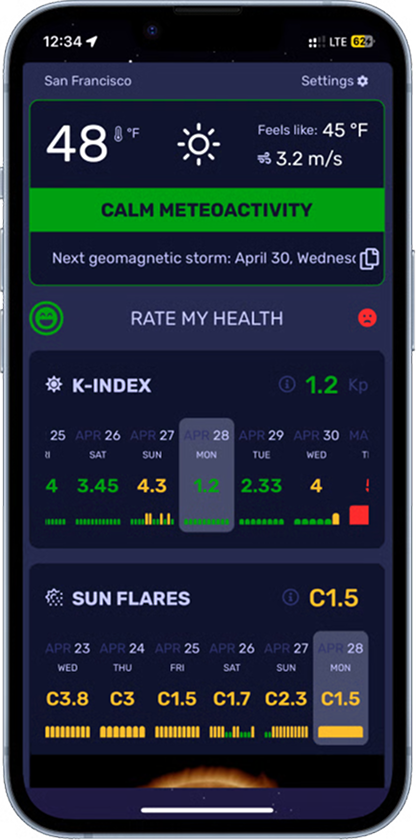
If you already suspect your sleep is more disrupted on active geomagnetic days, the threshold finding above gives a useful starting point: it's the stronger storms, not routine daily fluctuation, that the research associates with a measurable effect. Meteoagent tracks the Kp index and Schumann amplitude alongside each other, making it straightforward to check a rough night's sleep against what was actually happening in the geomagnetic environment the day and night before.
What is a circadian rhythm?
A circadian rhythm is the body's internal 24-hour cycle governing sleep, hormone release, and body temperature, coordinated by the suprachiasmatic nucleus in the brain. Light is its primary synchronizing cue, triggering melatonin release as darkness falls.
Can Earth's magnetic field affect circadian rhythms?
Some research suggests geomagnetic activity can act as a secondary zeitgeber alongside light. Studies have found reduced melatonin levels during periods of strong geomagnetic disturbance, though the effect only appears above a meaningful activity threshold, not during routine daily fluctuation.
How strong does geomagnetic activity need to be to affect melatonin?
A study in Alta, Norway found that geomagnetic activity needed to exceed roughly 80 nanotesla per three hours before melatonin levels were significantly reduced — a threshold well into moderate-to-strong storm territory.
What is cryptochrome and why does it matter here?
Cryptochrome is a light-sensitive protein central to the circadian clock that has also been shown, in several animal species, to respond to magnetic fields. It's the leading proposed mechanism linking geomagnetic activity to circadian and melatonin regulation.
Is the link between geomagnetic storms and sleep proven?
Not fully. Specific studies show measurable effects on melatonin above certain geomagnetic thresholds, but the research base is still small and the proposed biological mechanism needs more direct confirmation in humans before it can be considered settled.
How does this relate to Schumann resonance and sleep?
Both are proposed to affect the same melatonin-regulated sleep system through related pathways. Schumann resonance's 7.83 Hz frequency sits near the theta-alpha brainwave boundary, while geomagnetic activity is linked to melatonin suppression — two separate but overlapping lines of research into space weather and sleep.