



Meteoropathy
Napoleon reportedly needed calm weather before a battle. Goethe noted that low pressure made his work harder than high pressure ever did. Long before anyone measured a millibar, people were noticing the same thing: some bodies respond to shifting weather, and not always kindly. Today that response has a name — meteoropathy — and a growing body of research trying to explain why it happens to some people and not others.
What Meteoropathy Is
Meteoropathy describes a physical or emotional reaction to changes in weather and atmospheric conditions — not a single symptom but a pattern, triggered less by the weather itself than by how quickly it changes. Research consistently finds that symptoms tend to intensify just before or after a shift, rather than during stable conditions of any kind, which is why sensitive individuals often describe "feeling a storm coming" hours ahead of it.
It isn't currently a formal medical diagnosis. It's better understood as a recognized pattern of sensitivity, similar to how some people react strongly to certain foods or sounds while others don't notice them at all.
Who Tends to Be Affected
Estimates suggest that roughly a third of the general population reports some degree of weather sensitivity, rising to around 70% among people with diagnosed cardiovascular disease. Sensitivity also clusters in people with vegetative-vascular imbalances, chronic pain conditions, migraine, fibromyalgia, and certain mood disorders — one study found weather sensitivity scores were notably higher, and linked to a greater history of suicide attempts, among people with bipolar disorder.
Interestingly, more recent research pushes back against the assumption that sensitivity is mainly a personality trait. Newer daily-diary studies suggest weather sensitivity behaves more like an individual physiological threshold — something you either have or don't, largely independent of temperament — rather than a trait that maps cleanly onto being more anxious or emotionally reactive.
Common Symptom Patterns
Symptoms vary by person, but tend to cluster into a few recognizable groups:
- Head and neurological — headache, dizziness, ringing in the ears, difficulty concentrating.
- Cardiovascular — heart palpitations, shortness of breath, chest discomfort, blood pressure fluctuation.
- Nervous system — irritability, restlessness, insomnia, low mood.
- Musculoskeletal — joint pain, muscle aches, stiffness, particularly in old injuries or arthritic joints.
Most people experience one dominant pattern rather than all four, and the same person's pattern tends to repeat fairly consistently from one weather event to the next.
What the Research Shows: Barometric Pressure and Temperature
This is the best-supported layer of the topic. Multiple studies link falling barometric pressure and rapid temperature swings to increased joint pain, migraine frequency, and chronic pain flare-ups. Cardiovascular research has also connected outdoor temperature extremes to higher mortality risk among people with existing heart disease. The proposed mechanism is fairly intuitive: pressure changes can affect fluid pressure in joints and tissues, while temperature swings stress the cardiovascular system's regulatory effort.
The Space Weather Layer: Solar and Geomagnetic Sensitivity
Beyond barometric pressure sits a less settled but actively growing area of research: whether solar and geomagnetic activity affects the body through channels that have nothing to do with temperature or air pressure at all. Several studies have reported associations between geomagnetic activity and heart rate variability, autonomic nervous system rhythms, and inflammatory markers in blood vessels. Proposed mechanisms include effects on the body's internal circadian rhythm and its electromagnetic environment more broadly.
This research is genuinely earlier-stage than the barometric pressure literature — associations reported, mechanisms still being worked out, replication ongoing. It sits alongside the geomagnetic storm and Schumann resonance sensitivity discussed elsewhere in this wiki: consistently reported by sensitive individuals, worth taking seriously, not yet fully explained.
Living With Weather Sensitivity
There's no cure for meteoropathy because it isn't a disease — it's closer to a sensitivity to manage than a condition to treat. A few things consistently show up as helpful across the research: staying well hydrated, especially before humid or hot spells; keeping a light, nutrient-rich diet during unsettled weather periods; regular, moderate physical activity even when the instinct is to stay in bed; and — perhaps most practically — simply knowing in advance that a shift is coming, so symptoms register as expected rather than alarming.
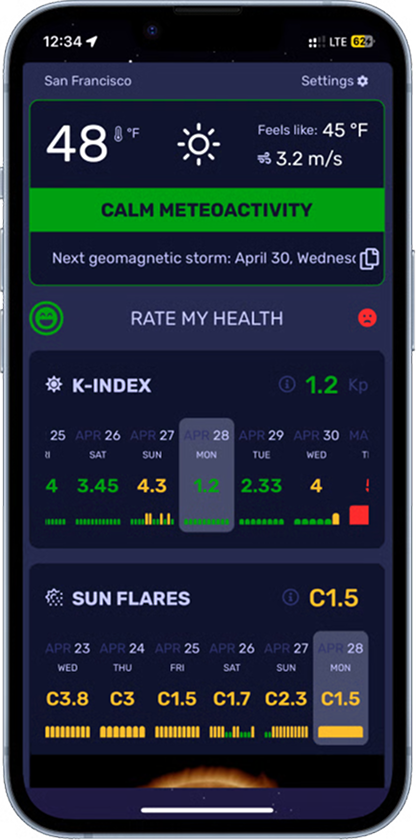
That last point is where tracking helps most. Many people find that noting their symptoms against the day's pressure, temperature, and geomagnetic conditions over a few weeks reveals a personal pattern worth planning around, even without a full scientific explanation for why it exists.
What is meteoropathy?
Meteoropathy is a physical or emotional reaction to changing weather conditions, with symptoms that typically intensify just before or after a weather shift rather than during stable conditions. It isn't a formal medical diagnosis but a well-documented pattern of sensitivity.
How common is weather sensitivity?
Roughly a third of the general population reports some degree of weather sensitivity, rising to around 70% among people with diagnosed cardiovascular disease. It's also more common in people with chronic pain, migraine, and certain mood disorders.
What are the main symptoms of meteoropathy?
Symptoms generally fall into four patterns: head-related (headache, dizziness), cardiovascular (palpitations, blood pressure changes), nervous system (irritability, insomnia), and musculoskeletal (joint and muscle pain). Most people experience one dominant pattern rather than all four.
Is meteoropathy caused by barometric pressure or something else?
Barometric pressure and temperature changes have the strongest research support, linked to joint pain, migraine, and cardiovascular strain. Geomagnetic and solar activity are a newer, less settled area of research, with reported associations to heart rate variability and inflammation but no confirmed mechanism yet.
Can you treat or cure meteoropathy?
There's no cure, since it isn't classified as a disease, but hydration, a nutrient-rich diet, regular moderate activity, and knowing changes are coming in advance are consistently associated with better symptom management.
Does personality make someone more weather-sensitive?
Older research linked traits like neuroticism to weather sensitivity, but more recent daily-diary studies suggest sensitivity behaves more like an individual physiological threshold, largely independent of personality traits.